
Your Pain Is FaceTiming, It Wants To Tell You Something
I recently had an amazing conversation with Dr. Kelly Clark, a physical therapist who owns Patient PT in Bloomington, Indiana, and I want to share something that came up that I think will change how you think about your pain.
We're constantly hearing in the pain science world that chronic pain is a "false alarm" or that our nervous systems are "overreacting." Kelly and I both have some strong feelings about this messaging, and here's why: your pain is not a false alarm. It's valuable data. We just have to learn how to understand that data.
Pain Is a Signal, Not a Problem
Kelly puts it perfectly: "Pain is a normal part of life and it is a really important biological signal that your body sends to help keep you safe." She goes on to explain that pain can tell you really valuable things if you know what parts of it to listen to.
Think about it this way - when your smoke detector goes off, you don't immediately assume it's malfunctioning. You check for smoke, look for fire, investigate what triggered it. The same logic should apply to pain. When your body sends pain signals, there's usually something worth paying attention to.
This is where the current pain science messaging gets it wrong. Instead of teaching people how to interpret and respond to their pain signals, we're essentially telling them their body's alarm system is broken. That's not helpful, and it's often not accurate.
The Real Problem: We Don't Know How to Listen
Kelly shared something that really stuck with me: "Pain gets louder and patients say that they're experiencing nine out of ten pain and ten out of ten pain over a sore shoulder essentially, because they're not listening to that pain and they're not listening to that pain because they don't know how."
Your pain might feel overwhelming because you haven't been taught how to work with it. Kelly uses this analogy that I love: think of pain like parenting a small child. If you ignore the child when they're asking quietly and respectfully for your attention, they will eventually start screaming. Your pain does the same thing.
When we learn to listen to smaller pain signals and respond appropriately, our nervous system doesn't need to turn up the volume. But if we keep pushing through and ignoring those early warning signs, the pain gets louder and more persistent.
What "Listening to Pain" Actually Looks Like
Kelly walked me through a fascinating case study about headaches that shows what this looks like in practice. She explained how certain muscle patterns - particularly the sternocleidomastoid muscle that runs from your clavicle to the base of your skull - can contribute to migraines when it gets tight from forward head posture.
But here's the key part: she can't just jump straight to working on that sensitive area near someone's throat. She has to build trust first, starting with less vulnerable areas like the shoulder, then gradually working her way to the more sensitive structures. The approach is just as important as understanding the anatomy.
This illustrates something crucial about healing chronic pain. Your nervous system needs to trust you before it will calm down. If you're constantly pushing through pain or ignoring what your body is telling you, you're essentially teaching your nervous system that you're not a reliable caretaker of your own body. This is counter to everything you might’ve thought before–that you were failing your body by not pushing it harder and “doing better.” But now you have the luxury of knowing how untrue that is, and that getting your nervous system to trust you again requires slowing down enough to simply listen.
The "No Pain, All Gain" Approach
One of the most important things Kelly shared was her rule for therapeutic exercise: it should never be more painful than the pain that was already there. She calls this "no pain, all gain," which is the opposite of the fitness world's "no pain, no gain" mentality.
This was huge for me personally. I shared how my husband (who's a personal trainer) would try to get me to do chin tucks for my neck pain, but they often made things worse despite being the mechanically-correct technique. The problem wasn't that chin tucks are bad - it's that there were other layers that needed to be addressed first, and I needed to start with much smaller, gentler movements.
Kelly explained that therapeutic exercise should help your nervous system trust you to interpret even small signals. When you can do that, it stops giving you so many huge ones all the time. But most people have been conditioned to think that if they're not pushing through discomfort, they're not working hard enough.
Why Validation Matters So Much
Something that came up repeatedly in our conversation was how crucial the relational aspect of healing is. Kelly mentioned that research shows whether or not you like your physical therapist is a huge predictor of how successful your therapy will be. There’s research showing this to be true for all health professionals, including therapists and doctors.
This makes sense when you think about chronic pain as a communication system. If you've been dismissed, invalidated, or told your pain isn't real by healthcare providers, your nervous system is going to be on high alert. You need someone who can explain why you're experiencing what you're experiencing and validate that your pain makes sense given your circumstances.
Kelly shared her own experience with chronic pain and how that helps her connect with clients. When someone with lived experience can say "I've felt that too, and here's why it's happening," it creates a foundation of trust that's essential for healing.
Moving Forward: What You Can Control
Kelly emphasized something I talk about a lot as a therapist: there are things in our control and things that aren't. We can't always control the pain, but we commit to learning the emotional flexibility skills that help us respond to the pain in a much healthier way.
This might mean learning new movement patterns, adjusting our environment to reduce stress, setting boundaries that protect our energy, or simply learning to start where we are instead of where we think we should be. Kelly named her clinic "Patient PT" because both patience and putting the patient at the center are required for this kind of healing.
The bottom line is this: your chronic pain is not evidence that your body is broken or overreacting. It's information. And with the right support and approach, you can learn to work with that information in a way that reduces suffering and increases your quality of life.
Your pain has been trying to tell you something. Maybe it's time to listen.
Disclaimer: Everything we discuss here is just meant to be general education and information. It's not intended as personal mental health or medical advice. If you have any questions related to your unique circumstances, please contact a licensed therapist or medical professional in your state of residence.
Destiny Davis, LPC CRC, is solely responsible for the content of this article. The views expressed herein may or may not necessarily reflect the opinions of the guest.
The content in this blog post comes directly from a real, human interview between Destiny and her guest on The Chronic Illness Therapist Podcast. This written version was formatted using AI. Listen to the full episode to hear the actual conversation.
Listen to Kelly’s interview with me, Destiny Davis, on Ep 103:Your Pain Is FaceTiming, It Wants To Tell You Something
-
Episode transcribed with AI and may contain errors that are not representative of the actual word or meaning of the sentence.
Kelly Clark, DPT
Destiny Davis LPC CRC: [00:00:00] All right. Kelly Clark is a Doctor of physical therapy and the owner and founder of Patient PT located in Bloomington, Indiana. P. Patient PT is a sensory friendly outpatient clinic offering physical therapy, massage therapy, and pelvic floor therapy. Cl, Dr. Clark specializes in treating chronic pain and patient education, education.
Destiny Davis LPC CRC: Well, thank you so much, Kelly. I'm really looking forward to this conversation today. Um. I love talking about pain and the science of pain and what can help make us feel better while remaining evidence-based and not making people feel like it's all their fault if they can't feel better, because there are things in our control and not in our control.
Destiny Davis LPC CRC: And so I think our topic today is gonna be, you know, around things that people can control, but with that added context of. know, here's the thing you couldn't control. Now here's how we can like, maneuver around that, or, you know, um, things like that. So please feel, please tell me in your experience [00:01:00] with chronic pain, chronic pain, uh, lived experience, professional experience, like what led you to this work?
Kelly Clark: Well, I've wanted to be a physical therapist since teenager. Um. I was in my thirties when I started PT school and I had already had some health problems of my own and a chronic pain journey that was kind of just beginning at that time and had a lot of difficulty getting good help and clear instructions on what I needed to do and why I needed to do it.
Kelly Clark: And as I continued through PT school, I just found that that was, uh.
Kelly Clark: Something that was very much missing from the physical therapy community. Uh, there's a lot of empowerment in the physical therapy world for athletes, but not so much for, especially folks with chronic pain, but even office workers and folks who [00:02:00] have more sedentary lifestyles. And we all deserve to have a life that does not include pain on a daily basis.
Kelly Clark: So that's started my clinic.
Destiny Davis LPC CRC: Yeah. I love that. Oh, I, it's, you know, we, yes, we all, we all deserve a life with no pain. Um, I What are some of the diagnoses that you work with and what maybe we can talk a little bit about? What are some common diagnoses that lead you to success with the no pain at all, versus maybe other things like I I, I work with a lot of, like, Eller, Sandlos client PA clients, um, people with genetic conditions that are never gonna go away.
Destiny Davis LPC CRC: So maybe we can talk a little bit about the difference between, you know, what's treatable, curable versus not treatable and making it manageable, but not a cure.
Kelly Clark: Well, to me there's very little true difference between those two things because pain is a normal part of [00:03:00] life and it is a really important biologic signal that your body sends to help keep you safe. So some pain, especially given certain circumstances, including things like hypermobile, el Stanler syndrome, uh, can involve more pain than most people experience.
Kelly Clark: And that's actually where a lot of chronic pain begins. We are really young. We are, uh, still in development and under. Heavy influence of parents, teachers, peers, and we may find ourselves to be a little bit more sensitive than others and not realize what that means, or a little more mobile than others and not realize what that means and how to cope with it.
Kelly Clark: And the whole theory behind my practice is to accept wherever you are and start there. Working on the factors that you really can control, and I feel [00:04:00] really empowered and as though I am in a uniquely fantastic position to help people with these things as a physical therapist because the movement of your body.
Kelly Clark: Uh, and the musculoskeletal system as a whole are one of the only things in our body that we do actually have true volitional cognitive control over. We can, for the most part, control how we move and learn how to rewrite our movement patterns in ways that are more adaptive to modern life or our personal circumstances.
Destiny Davis LPC CRC: Yeah. I, I appreciate that. Uh, expansion. What are some of the main things that you to teach people around movement? Um. Do you start with a lot of the, maybe like the psychological side of, you know, why and, and why this is important and what they wanna get out of it? Or do you do, is a lot of your education around the biomechanics of, of [00:05:00] how to move without pain?
Destiny Davis LPC CRC: You know, maybe you can share a little bit about what that process looks like for a new patient.
Kelly Clark: So for a new patient, one of the things that's the most noticeably different. When they first walk in is that we spend a little bit more talk, more time talking than an average physical therapy appointment. There is plenty of time for folks to relay to me their entire medical history if they want to, no matter how complicated it is, um, and especially if they feel it's relevant to the pain that they're experiencing on a day-to-day basis because.
Kelly Clark: My patients mostly tell me where their pain is coming from and what they really need is somebody to explain to them. Why they're right about where that pain is coming from and what they can do about it. And so it's really variable from that point forward, what I do with a patient. But it almost always starts with education on what the natural and biomechanical limitations of your joints are or [00:06:00] are supposed to be if you're hypermobile, for example, or have some other difference.
Kelly Clark: Um. And then going from there and teaching you how to do a few simple exercises that start you on the journey towards correcting anything that you can,
Destiny Davis LPC CRC: I love how you said
Kelly Clark: um.
Destiny Davis LPC CRC: to explain to them why they're right first. 'cause that's, I think, so pivotal that the pain is there. Um, we wanna know why, and then, and once we are, once we understand why, then we're usually pretty invested in, okay, I trust that you can help me move out of this
Kelly Clark: Exactly, exactly. It's not normal for us to be in pain all the time, but pain itself is normal and can tell you really valuable things if you know what parts of it to listen to.
Destiny Davis LPC CRC: right. How did your training as a PT help you with that? And then what else [00:07:00] did you have to do outside of PT school to continue developing in this particular niche? Uh.
Kelly Clark: Well, PT School helped me to understand ultimately how our bodies work in a way that. I don't think that anyone, uh, outside of. Like doctorate level healthcare often gets to experience. Obviously you can get there with intensive self-study and chronic pain patients especially have a very good reason to do that.
Kelly Clark: But, um, physical therapy school is a really well-rounded education, uh, as far as teaching you about all the different systems of the body, including the skin. Uh, and that also helps us to understand the struggles of hypermobility. Patients really well because skin, uh, is just another connective tissue in some ways, or at least it's got a lot of layers of connective tissue in there.[00:08:00]
Kelly Clark: And, uh, okay. I feel like I'm kind of out in the weeds, so I.
Destiny Davis LPC CRC: No, no, this is perfect actually, it that's a great, that's a great, because you're right, like actually I've, I've interviewed so many PTs and I never knew that skin was actually something that y'all study, so I'm, that
Kelly Clark: That, that's a unit that's actually been added since, uh, physical therapy became a doctorate level program. And, uh, when you're in PT school, it's called integumentary, uh, usually because that's the name of the system that is our skin. And we learn all kinds of cool stuff about wound care and taking good care of your skin, which is a surprisingly important part of health.
Destiny Davis LPC CRC: that makes so much sense. And I agree. I think chronic pain patients are definitely researching the body. I know my own. in the body has sparked from my experience with chronic pain and. Yeah, like anatomy. And I joke because I failed anatomy and physiology [00:09:00] the first time I took it because I just stopped showing up to class.
Destiny Davis LPC CRC: I didn't know that you could withdraw from a
Kelly Clark: Oh no.
Destiny Davis LPC CRC: class. So like could have, I could have withdrawn and like gotten a W and instead I got an F because I just, I was young. I, and looking back though, the things that are really important to me, and we can, this probably will weave into this. Conversation, but the things that are really important to you can also cause you the most amount of anxiety. And I think I was so anxious about getting it wrong, and I just was like, I can't do this. But that, I took it again two years later and got an a and like, it's just, it was my favorite class and I, I love learning about the body.
Destiny Davis LPC CRC: It's so interesting to me. Um, and I, I think most chronic pain patients. Uh, like to, but maybe don't know where to or how to. So I think there's no one better than PTs to do that work with clients. Um, there's that. Do you, um,
Kelly Clark: There is a but though, and that was the second half of your question that I never got around to when I [00:10:00] got lost in the weeds there. But that is what I had to do outside of PT school and, and the things that I wasn't necessarily prepared for and. You know, one of the things that a lot of folks don't understand about PT school and probably also about medical school, is that you are hit with this like enormous fire hose of information that a lot of times really does require a lot of rope memorization and, uh, everybody gets wet, but not everybody gets wet with the same water.
Kelly Clark: You. You come away after your boards exhausted, and then the things that are the most important to you are what sort of rise to the surface. And for some folks that ends up being insurance requirements or emergencies in the clinic or whether or not they're actually finishing and starting their appointments on time.
Kelly Clark: And so that's what brought me into private practice because I feel like, especially in the chronic pain universe, attention is so crucial and most physical therapy [00:11:00] environments are so busy and attention is split, and there are often a lot of people doing all the same exercises. All at the same time, and no one really knows why.
Kelly Clark: I wanted a nice, quiet environment where I could explain things to people and share my own experiences too, because relational uh, therapy is just as important as physical therapy when it comes to chronic pain.
Destiny Davis LPC CRC: Yeah. Can we talk a little bit more about why that is in, in your experience and opinion?
Kelly Clark: uh, research has shown in physical therapy that whether or not you, like your physical therapist is a huge predictor of how happy you are with your therapy and even your success. And. I found myself during clinicals really recognizing that a lot of people with longer term problems and more of those why questions that often get brushed off.
Kelly Clark: They [00:12:00] weren't taken seriously and they weren't really clicking with their therapists either. And so
Destiny Davis LPC CRC: Yeah.
Kelly Clark: I, as a, uh, former chronic pain patient and as a person who also happens to come from a family background with no doctors and what. We would call in the healthcare universe a relatively low health literacy, which really just means we didn't have, uh, access to really great medical care.
Kelly Clark: So we didn't know a whole lot about what the healthcare world had to offer us and how to take good care of ourselves, which is the case for a lot of people in the chronic pain world too. So by sharing my. Experiences with chronic pain, it helps people to understand they're not alone, that their experiences are much more normal than a lot of the healthcare world leads us to believe, um, and that their experience of those things, even if it's a little more intense than.
Kelly Clark: The average person or the person who happens to be [00:13:00] sitting across from them in a white coat, that that doesn't mean it's not valid. And that validation is so important for chronic pain sufferers because they end up being invalidated constantly. And a lot of times the only solution on offer is a terrifying surgery or a pharmaceutical with all sorts of side effects, and that might not even work or work for long term.
Destiny Davis LPC CRC: Right. Yeah. Yeah. I think, you know, one of the things in which we look for as patients when we are deciding if we like our practitioner or not, is one, yeah. That we don't feel dismissed, but we also wanna know that they are knowledgeable in exactly what we're dealing with. Like that, that's a part of that.
Destiny Davis LPC CRC: And I think that's why these specialties are, are so important. To talk about when, you know, you've got someone who really understands hypermobility, really understands the pelvic floor, et cetera. 'cause it, it's a part of that trust building factor. And, um, yeah, I, I [00:14:00] also grew up in a family that had no health literacy.
Destiny Davis LPC CRC: And it is so interest, like in my, in my family with, like, with my husband, there's no like mechanic literacy. Like we, he doesn't know anything about our cars. I
Kelly Clark: Exactly.
Destiny Davis LPC CRC: like I grew up with. Mechanics and carpenters and like, I can barely hang a shelf in my house. So like, you know, it's just a different, it's a different world. Um, and you know, as someone who's in chronic pain or deals with it, uh, on and off it, I think. Yeah, having, my husband is a personal trainer with a master's in, in
Kelly Clark: Awesome.
Destiny Davis LPC CRC: just having him like around in and of itself, like helps me to lose some of the fear. The other piece I wanted to say, I got, my brain got sidetracked, but um, oh, fear.
Destiny Davis LPC CRC: It was around fear. Um, shoot. I lost it again.
Kelly Clark: Hopefully I [00:15:00] come back.
Destiny Davis LPC CRC: Um, yes. Fear. I was gonna say something about fear in the body. Fear of pain. You said something, sparked it. I know it's gonna come to me one second. It is like right there. It's like, I know, and it's not coming. That's okay.
Kelly Clark: Maybe it was around fear of
Destiny Davis LPC CRC: it just,
Kelly Clark: I feel like we were kind of getting close to that topic, but.
Destiny Davis LPC CRC: yes. Fear of movement
Kelly Clark: As relevant to chronic pain.
Destiny Davis LPC CRC: normal. Normal. I got it. Thank you. Normal. So the thing about that, the comment around like most of our experiences are actually way more normal than we think. I think [00:16:00] in the past, and I think there still are a lot of people that would get angered by that because we've been led to believe in this society that the only way you're going to get help is if there's something dangerously wrong. And so I think you know your body. If no one, if you keep getting dismissed and dismissed and dismissed and nobody is helping to explain why and what's happening and then how simple movements and simple things can help it. you know, let's say someone does explain it, but then they go into their environment that is not conducive to nightly exercises, deep breathing, relaxation. You know, we can talk a little bit about that kind of socioeconomic status also. Money sometimes has nothing to do with it when you just live in a high stress
Kelly Clark: Yep.
Destiny Davis LPC CRC: So then the simplicity of the, the treatment plan really invalidating. 'cause it's like, you know, you it, it's not working. And then you're like, well then there must be something seriously [00:17:00] wrong. It must be beyond this. that is tricky. And that's where a lot of the therapeutic work comes in. 'cause we are doing a lot of work around. When we say minimizing stress, it's not just thinking your stress away, it's saying yes to the things that you, that are important in your life, saying no to and having boundaries with people who take too much from you or, you know, things like that. So all of it plays in together, and it's sometimes a little bit like a, a puzzle, uh, a jigsaw puzzle, really complicated. But once you put the pieces together, it becomes really clear.
Kelly Clark: You know, I have so many thoughts in response to that. I feel like we're both doing this, like we're both saying things that the other one finds so fascinating and there's like seven thoughts like streaking off. I think I'm gonna grab a sheet of note paper actually so that I can start taking a couple notes, but, um, okay.
Kelly Clark: You reminded me of one of the fundamental reasons that I [00:18:00] went into private practice while you were talking about some of those things. So. There is no one out there who is especially designated to explain things, the implications of health issues, what you can do in order to avoid them in order to, you know, slow them down in order to even heal them.
Kelly Clark: There is no one in the healthcare universe that is specifically designated and qualified to do that better than physical therapists, in my opinion, but we are. Running into the same situation where we have this like deeply siloed scope of practice and people can only get coverage for very specific types of physical therapy.
Kelly Clark: Um, and a lot of times it is associated with a serious injury or rehab from a surgery like a knee replacement. But where do the people who have. Pain and don't know what to do about it. Go. Where do people who have [00:19:00] an unexplained pain especially go to get to the bottom of that and not just get another prescription for a painkiller or for a surgery?
Kelly Clark: And that's something that, um, I. Learned very, um, sort of clearly and in a stark fashion while I was in my clinical rotations for physical therapy school. Because one of the things that you mentioned is if it's not an emergency, it's not important enough to get treated or, or something like that. And. The reason that patients have that perception, this was mind blowing to me.
Kelly Clark: Okay. The reason that patients have that perception is because especially in a lot of healthcare environments, and especially especially hospitals, that is true. In hospitals,
Destiny Davis LPC CRC: Yeah.
Kelly Clark: people are under some of the most stressful conditions that they have ever been in in their lives, and they are understandably really [00:20:00] emotional about it.
Kelly Clark: But the people who work in the hospital are also a lot of times under extremely high stress conditions and have limited resources and a limited, very siloed. Role at that hospital and so. I, when I was in my clinical rotations, which is just a part of the education, uh, for physical therapists, uh, for the audience.
Kelly Clark: Um, I was in a hospital and I asked if I could observe on the psych ward. Okay. Uh, the, the floor of the hospital that was folks who had been admitted for, uh, psychologically related problems. And the patient that I was assigned to was an older gentleman. Who had been admitted because he had recently acquired a gun and his, and he was threatening family members at times, and his family was scared.
Kelly Clark: So they took him to the hospital, admitted him [00:21:00] against his will. Um, and when I saw him, it was very clear to me, based on my education and exposure to a variety of different patients that he. Had some form of dementia, Alzheimer's, something like that. It was very, very, very clear. And so my first question to, uh, the ci, the clinical instructor, was, has anyone told the family why he's behaving this way?
Kelly Clark: And the answer was, to my knowledge, no. And I said, okay. When. Are we gonna tell his family that this is probably why he's behaving this way and get him referred to a neurologist or some other appropriate professional? And I was actually asked if I wanted to do it.
Kelly Clark: And [00:22:00] I said that I didn't feel like that was my place because A, I'm a student. B I'm a physical therapist. CI am not qualified to diagnose a neuropsychological disorder. And they said, okay, well it's not my job either. And that's,
Destiny Davis LPC CRC: Oh
Kelly Clark: and that is. A kind of extreme example, but similar things would happen with, um, medical patients as well.
Kelly Clark: There was a gentleman who checked himself out against medical advice when he had a, um, GI bleed, a gastrointestinal bleed, and it was taking a very long time to figure out why and where the bleed was coming from. And he, um, had an addiction. That, uh, was very pressing in his mind and, um, decided to check himself out.
Kelly Clark: And again, I was the naive student [00:23:00] asking the nurses whose job it was to explain to him that he might die from this gastrointestinal bleed if he didn't figure out where it was coming from. And it was no one's job.
Destiny Davis LPC CRC: Yeah. Oh my gosh. Everyone's so scared of.
Kelly Clark: Exactly. And um, it's in the physicians and nurse practitioners worlds in the hospital world. I don't blame them. Um, liability is a huge factor in your life, your livelihood in the physical therapy world, because most of our techniques are non-invasive. I feel like we have this freedom. And to me, responsibility to use our education to its absolute best ability for every patient.
Kelly Clark: And in my case, I can do the most good for chronic pain patients because I understand their journey. I [00:24:00] empathize with their journey, and I can walk them through step by step what they can do to recover from it. And um.
Destiny Davis LPC CRC: Yeah.
Kelly Clark: One thing that we got away from earlier that I did wanna circle back around to is the sorts of things that you can, um, help and potentially heal, and the things that you just have to learn to manage.
Kelly Clark: Um, most musculoskeletal pain disorders can be what, uh, would be called healed. Uh, in that you can. Reduce the pain to zero and allow a string of zeros to accumulate over time. Okay. There are certain folks, especially, uh, folks in the hypermobility world, folks who have had traumatic injuries, folks who have a lot of scar tissue that needs, um, some sort of physical remediation sometimes, uh.
Kelly Clark: They do experience more pain [00:25:00] more frequently, and it's even more important for them to understand what that pain is telling them so that they can do anything that they can about it and minimize it. And sometimes for more people than you would think that's enough, especially when you can rewrite those day-to-day movement patterns that sometimes are exacerbating with every single time you move your arm like that.
Destiny Davis LPC CRC: Yeah. Yeah. This is where I get so like hung up in the pain sensitization science world kind of thing because they love to talk about pain as a false alarm or overreacting, and I just don't give a shit if it's an overreaction or not. It's like it's, it's data and that data doesn't need to mean. I think before the message was, pain means something and therefore again, it's the most dangerous.
Destiny Davis LPC CRC: Like, and then therefore, if it's not the most dangerous, then it doesn't mean anything. It's like where, why it's not this hard. It's not that hard to just say pain is a signal. [00:26:00] May not be a life death situation signal, but it's a signal. We need to learn how to move around it or with it in a
Kelly Clark: And pain can adapt to anything that you can think around it is, is what so many folks I feel in the pain science universe don't understand. You know, the whole like pain can be a false alarm and central sensitization conversation like. I feel like that research is getting at something, but it is so incomplete and so in its infancy and does not in any way reflect the average experience of a person who's experiencing pain on a day-to-day basis.
Kelly Clark: Pain gets louder and patients say that they're experiencing nine outta 10 pain and 10 outta 10 pain over a, you know, sore shoulder essentially. Because they're not listening to that pain and they're not listening to that pain because they don't know how, nobody's telling them what to do with that information.
Kelly Clark: And so I feel like a lot of us as professionals in at least the physical therapy world, are failing those [00:27:00] patients because we are afraid to step a tiny bit outside of this box that we're in and say, I feel that sometimes too.
Destiny Davis LPC CRC: Yeah.
Kelly Clark: it, it can be uncomfortable to have conversations with folks where you challenge their beliefs.
Kelly Clark: And unfortunately in my role as a chronic pain physical therapist, I have to do that kind of a lot. But when you do it gently and with empathy and with understanding, and with the goal of helping, all those things are so important,
Destiny Davis LPC CRC: Yeah.
Kelly Clark: uh, you can do it. You can change people's lives. I've helped people deal with pain that was plaguing them intermittently for 37 years.
Kelly Clark: Have total remission of that pain and spot the early warning signs so that they can then stop it before it becomes so intense again. And that's where it's at. That's [00:28:00] what I think all of us would be able to do if there was a little bit more emphasis on how our bodies work built into our education system.
Kelly Clark: But so far we're not there.
Destiny Davis LPC CRC: totally. Yes. Yes. Do you know, do you know Rick Alderman? Have you heard that
Kelly Clark: I don't think so.
Destiny Davis LPC CRC: He's a pt. He has like a. Like a ton of books and stuff. So I, I just, um, him a couple weeks ago and he was talking about how, and I read his book and it was great. And, and, and it's all about like putting all of the different kind of. Small pieces together to see like a whole body, whole system approach. And he kept saying his book wasn't, or I, he just said it wasn't evidence-based and that that, and I'm like, it is evidence-based, but because there hasn't been a, a randomized controlled trial on the body as a whole, you can't call it evidence-based.
Destiny Davis LPC CRC: And it's like nothing he was saying
Kelly Clark: Yeah.
Destiny Davis LPC CRC: there. Like it was all just, again, kind of similar like [00:29:00] movement patterns. How you're moving your body, how the fascia, you know, is attached and connects and all of that. So I think it's just important to recognize that some people go way outside of evidence bases and do a lot of harm and danger because something. Seems logical in your mind from your worldview, and then therefore you use that as a treatment modality and it can do a lot of harm, but I don't know, our evidence-based modalities also do harm, so I think we just need that nuance of. I think it's important to not go too, too far outside of what we do know is helpful and works, but to package it up in a way that is with that humanity piece.
Destiny Davis LPC CRC: You're never gonna be able to research that. Like, that's never gonna be done in a, in a randomized, controlled trial. So we have to allow for some nuance there.
Kelly Clark: That's one of the things that a lot of folks. Really don't understand, I think even from inside the healthcare universe, but you know, the scientific [00:30:00] method is fantastic. Randomized controlled trials are great evidence for certain types of interventions, but unfortunately, when it comes to complex systems.
Kelly Clark: Like the human body, which is one of the ultimate complex systems. But even just the musculoskeletal system or the neuromuscular system or the neuro, uh, I lost the phrase nervous system. Um, they are infinitely complex systems. And to design an experiment that could actually account for all the potential confounding factors is.
Kelly Clark: Extremely difficult, if not impossible. Um, and that's why there isn't evidence for some of these things. But what I feel I see a lot of is, you know, as physical therapy has continued to become more and more evidence-based, there's been this failure to extrapolate from that evidence. There's not a whole [00:31:00] lot of clinicians who actually work with patients speaking up about what works face-to-face with patients.
Kelly Clark: There's virtually no emphasis on case studies because it's considered low level evidence. But I can teach people so much just by giving them the case study of myself. And the various aches and pains and injuries that I've experienced in my life. And so, um, I would really love to see more relevant evidence coming from clinicians as opposed to folks that are trying to design the perfect lab experiment because it doesn't exist when it comes to human beings.
Destiny Davis LPC CRC: Yeah, I agree. I agree. What are some, do you want to go over a particular case study, whether it's your own, your own life that you wanna go over here and give an example for people or, or maybe a, a common thing you see in clinic[00:32:00]
Kelly Clark: Um.
Destiny Davis LPC CRC: and how you work with them and kind of, course there. That's a broad question. There's some, you know, it depends on the presentation I'm sure.
Kelly Clark: Well, there are so many different kinds of pain that I work with that it is kind of hard to pick an individual case study because um, there are some that are just so fascinating. Migraine can be treated with these methods. Prostatitis can actually be treated with physical therapy pretty successfully. Um.
Destiny Davis LPC CRC: Wow.
Kelly Clark: Like maybe edit that one out. That's sort of a controversial thing to say. And I am not a pelvic floor therapist. Um, so I probably shouldn't be talking about prostatitis, but I just find that one fascinating. Um, as far as far as my work with clients, probably what I see more of than anything else is hip and low back pain.
Kelly Clark: But I also see a lot of neck and shoulder issues and headaches and I.
Destiny Davis LPC CRC: let's do headaches. That one is
Kelly Clark: [00:33:00] Headaches is headaches. Okay. Um, let me see if I've got my. Okay, I might be able to get us a little visual aid here. So headaches are an especially intriguing topic to me relatively early in my private practice. I had a chronic migraine, uh, client come in and they really liked hands-on therapy. And in addition to being a physical therapist, I've been licensed as a massage therapist for about 20 years, uh, 20 years in two days actually.
Kelly Clark: Um, but. Uh, so we would do a lot of manual therapy and, um, I worked on that person for a really long time and, and I found that there was a specific set of muscles that was almost always tight on this person with migraines. Okay. So, um, it was this upper trapezius, okay, at the base of the skull. Oh, that's not the right one.[00:34:00]
Kelly Clark: So upper trapezius was always really stiff. They also, if you turned around to the front, would also have a really tight anterior deltoid portions of peck and pec minor that's directly underneath, but most intriguingly and most persistently was sternocleidomastoid. Okay. Oops. Popping up there. So sternocleidomastoid is this muscle that runs from your clavicle to the base of your skull, and it connects very close to the upper trapezius.
Kelly Clark: And the one of the most common postural distortions that we note in the physical therapy world is head forward and.
Destiny Davis LPC CRC: Mm-hmm.
Kelly Clark: It's often paired with shoulders forward or protracted shoulders. Okay, so [00:35:00] people call this tech neck a lot of the time these days. Okay. And it can eventually lead to you getting kind of a hump on your back, which is why people are concerned about it.
Kelly Clark: 'cause you know, we're all a little va Well, the thing that a lot of people don't understand about the musculoskeletal system and the nervous system is that they are all layered up on top of each other. Okay? So we take the sternocleidomastoid and, uh, maybe it's not immediately apparent why that would be a problem until you pop the nerves on.
Kelly Clark: So those yellow lines are all nerves, and if I hide the sternocleidomastoid, they're exposed is what we call the brachial plexus. And the brachial plexus is this huge bundle of nerve fibers that supply the motor control and sensation return to your entire arm. And so that's why things like thoracic outlet [00:36:00] syndrome, carpal tunnel syndrome, migraine neck stiffness, often are all clumped together, even frozen shoulder.
Kelly Clark: The thing that was really fascinating to me and kind of the, this, you know, maybe I'm giving away a trade secret here for any physical therapists that are listening, I could not make any headway with this migraine patient if I started right there. On Sternocleidomastoid. Okay, because guess what? On a real human body, it's right next to your throat.
Kelly Clark: It's a very vulnerable place. But if I start
Destiny Davis LPC CRC: totally.
Kelly Clark: at the shoulder with that anterior deltoid, with pec and pec minor, just close to the shoulder, okay? I didn't get down into the chest region because that's a little bit more intimate. Uh, if I started there, I could progressively work my way in closer and closer to those sensitive structures.
Kelly Clark: I would usually move on from peck and anterior deltoid back to upper trap, and then to [00:37:00] sternocleidomastoid. And if sternocleidomastoid was responsive, I could then move on to scalings, which are even more intricately like wrapped around that brachial plexus. So these are real physical structures that we can have an impact on, not just as physical therapists, but also as massage therapists.
Kelly Clark: And on top of that, as patients though, I will say, if you want to work on your own neck, first of all, I don't really recommend it. I don't have much success in it myself, even with 20 years of experience. But if you're gonna do it, lay down and try to keep your arm as relaxed as possible. Make sure your head is supported if you're going to do self massage on any of these sensitive structures.
Kelly Clark: And listen to your pain if you're going to be doing self massage on any of those sensitive structures, if it hurts. Um, okay, so how much pain is too much pain? This comes up all the time. In my work I like to talk about it. Comes to manual therapy, good pain and bad pain. Good pain is when it feels like I am [00:38:00] relieving an existing pain.
Kelly Clark: Bad pain is when it feels like I am inflicting a new pain on you. And so when you're doing self massage, use that rule of thumb. If it feels like you are just pinching yourself and causing more pain than was there before, cut it out. Just stop. Move on to something else at, at a bare minimum. Um, but it's the same thing when I'm working with folks.
Kelly Clark: You know, I have to know how to approach things. The approach is just as important as the information that you're presenting and the actual like, fine details of what's going on in that person's musculoskeletal system. So getting a little long-winded there already. But it often starts with building that trust between yourself and that client or patient and letting them know that you can help them.
Kelly Clark: If you can actually lay hands on a person and give them any form of relief, that is one of the most convincing things that you can possibly do as a healthcare practitioner. And there are certain branches of, [00:39:00] uh, the manual therapy universe that I feel take advantage of that. Uh, but that's a topic for a different day.
Kelly Clark: In my universe, however, I'll, I will oftentimes start with a little bit of gentle treatment and then move on to explaining, this is what I just did, and this is why if you do chin tucks, these various muscles are going to be under less strain and come into better balance to keep your head directly over your shoulder where we want it, and your shoulder not way up on the front of your body like Herman's.
Destiny Davis LPC CRC: I feel like that was just such a masterclass. Thank you so much. Um, and it's totally my experience. I and my husband would try to get me to do so. He would try to get me to do chin talk for forever. I mean, he always said I was his worst client because I was so difficult. But the fact of the matter is. He, he didn't, he didn't, not his fault, but he didn't have, even though he's so knowledgeable, like he didn't, the way that you just showed that, um, [00:40:00] the, the muscle and the nerves and then behind the muscle, and like, I feel like all of my clients need that app because. And to just play with it. Like just play with the app and just learn your body because it makes everything make sense. And there's more buy-in for doing these things. And now, like it used to be like doing the chin tucks, especially I would be, I would lay on the floor and kind of push my head into the floor with my chin tucked and hurt worse.
Destiny Davis LPC CRC: Like you said, it was bad pain. But in his mind, he knew that was what I needed. And you know, it was now I can do them and if I even feel a migraine coming on it, it's gone. But at that time, there were other layers that needed to be addressed first. Go
Kelly Clark: So I, I will, uh, have a tiny beef with your husband here. Okay. So,
Destiny Davis LPC CRC: please.
Kelly Clark: um, what I would say is therapeutic exercise should never be painful. Um, it especially more painful than that pain was before you started doing it. And that's something I actually work with chronic pain patients [00:41:00] on a lot. A lot of times people have been told that they need to do it exactly this way, and even with resistance or whatever, with whatever exercise.
Kelly Clark: And if they don't feel like they're really like getting a workout, they feel like they're not doing the work and sometimes the work
Destiny Davis LPC CRC: And that
Kelly Clark: is being patient.
Destiny Davis LPC CRC: yeah. Yeah. That was the big change for me that came through somatic work and therapy and like, that was like, like you, my own self learning around it all. Like when I started to learn that less is better and to, um, in somatic experiencing that I'm, I'm trained in, we, we talk about like, uh, titrating very slow amounts at a time and was kind of the foundational rozen.
Kelly Clark: No, I'm.
Destiny Davis LPC CRC: Oh, okay. Okay. Um, that was like the foundational, so I started to change what he was giving me, even though he, he wasn't able, he wasn't able to like, you know, um, [00:42:00] train me in the way that my nervous system needed. But through my own self-learning, I was like, okay, this is what he is saying, can I do like a 10th of it?
Destiny Davis LPC CRC: And that was how I
Kelly Clark: Bingo. And that's exactly how so many people need to start when it comes to therapeutic exercise. First, they need somebody to carefully coach them through exactly how it's supposed to look and feel. And then they need to really feel into it themselves and figure out where that therapeutic level is. And sometimes when you are watching somebody doing these exercises, they're just in a rush and you know, a chin tuck that looks like this or like this is a very different thing from a chin tuck that looks like this.
Destiny Davis LPC CRC: Yeah.
Kelly Clark: And so much of it is learning how to do a controlled contraction and relaxation in a pain-free range, and then building strength from there. [00:43:00] But people don't get encouragement to actually start from where they are when they're in pain all the time.
Destiny Davis LPC CRC: No they don't. I can definitely attest to that, I think it's a mixture of they don't get the right. Support and then that's very much internalized. I remember the first time that I went to a restorative yoga class because, uh, yoga was not my thing at all. And I just, I was like, let me just, you know, I've heard about this.
Destiny Davis LPC CRC: Let me try this. And she was encouraging us to use blocks and blankets to basically. Allow for the least amount of tension. So you can lean, you can lay and lean in. And I was like, that's bullshit. Like, I am not here for that. I can do that at home. Like, like, I'm not here for that. I'm here for some work.
Destiny Davis LPC CRC: Gimme the work. And, but you know, it stuck with me. So it didn't, in that class, I, I couldn't get past it. But like throughout the years and then especially as I was in somatic experiencing training, I was like, okay. I get it. [00:44:00] Like this is, this is what we need. and so now I try to convince clients to do it, and they're, I'm like dealing with the same thing that I, they're like, no, like I'm not doing that.
Destiny Davis LPC CRC: I need more. I need to just get past this. And I'm like, all right, we got lots to, lots to work on here.
Kelly Clark: I think a lot of that comes from in the exercise universe. Uh, fitness and losing weight are so much of the emphasis when it comes to exercise, and so there is a real no pain, no gain attitude. And when it comes to healing chronic pain, the attitude needs to be no pain, all gain.
Destiny Davis LPC CRC: Yeah. I love that. Yeah.
Kelly Clark: say that to clients all the time, and it's really true. You need to help your nervous system trust you to interpret even a small signal. And then it will stop giving you so many huge ones all the time. You know, uh, I like to tell people that when it comes [00:45:00] to, um, their pain, they should think of it as very similar to gentle parenting, a small child.
Kelly Clark: Okay? If, if you ignore the child when they are. Asking you quietly and respectfully for your attention, they will eventually start screaming. And your pain does the same thing. If, if you learn how to tough it out through weaker pain signals that pain will get stronger and stronger, including, uh, folks who end up with prescriptions for really strong painkillers or even pain pumps.
Destiny Davis LPC CRC: Yes. Yep. I agree. It's, um, learning, I, I talk about that a lot with clients too. The learning to trust your, well, your body, learning to trust you, that you're not gonna push it past its limits, and we have to slow down to speed up.
Kelly Clark: That's so crucial. So crucial we talk there. One of the things that comes up a lot in the PT phys, [00:46:00] uh, pt, chronic pain universe is pacing. It's one of the only things on offer in a lot of physical therapy, uh, clinics for chronic pain patients. Um. I think a lot of people really, uh, don't get good information on what pacing means when your body is in full blown emergency mode, which a lot of times if you've had a pain for years and years that has not been adequately addressed, your body is kind of in emergency mode and it affects your cortisol levels, levels sometimes your blood pressure, your heart rate, your sympathetic versus parasympathetic activating.
Kelly Clark: It is, it's, it's all in there. I lost that one too. I'm, so,
Destiny Davis LPC CRC: Yeah, I, I meant you broke
Kelly Clark: I said, I'm so glad you edit this.
Destiny Davis LPC CRC: Oh, yeah. I know I, yes. Um, yeah, I think that, again, [00:47:00] like I'm so glad we talked about pain sensitization and how the science world, I think is just getting it wrong right now. Um, because it is in an in, in its infancy even. I really like to tell people like pain reprocessing the is growing a lot right now. Have you
Kelly Clark: I don't think so.
Destiny Davis LPC CRC: It's, it's, it's made for therapists, but it, it's about, for mental health therapists. Um, but it's all about pain, sensitization, and, and they'll use a little bit of somatic experiencing in it. And, uh. It. Their randomized controlled trial was done on low back pain, and so then they talk about how 86% of the clients improved and wonderful, but now people are trying to put that on fibromyalgia and EDS and basically any chronic pain ever, and it's like there's no basis for that whatsoever. it's really
Kelly Clark: That is really frustrating, uh, especially considering that that's sort of a new and trending therapy.[00:48:00]
Destiny Davis LPC CRC: Yeah. Yeah, exactly. I know someone's probably gonna like send me a cease and desist 'cause I've been talking about it a little bit too much and, and I'm not a fan of it. Um, for that reason I think it's. I think, you know, when I look at the, the manual for how to do that therapy, it's a lot of the stuff that I actually do with clients, but I just hate how it's being packaged and sold as a, a cure to chronic pain without the nuance for, um, what kind of pain.
Destiny Davis LPC CRC: Again, despite the randomized controlled trial being with low back pain only. So that, that's my, that's my
Kelly Clark: So much of pain, science, treats pain as if the pain is the problem, and I. The pain isn't the problem at, as I said earlier, the pain is a valuable biologic signal that your body uses a lot of resources to [00:49:00] produce for a very important reason. There is a problem behind the pain in every single chronic pain scenario I have ever faced it.
Kelly Clark: It is mind boggling to me that. There are so many therapies that aim to find a one size fits all solution for pain without ever identifying why it hurts in the first place. To me, that seems like it should absolutely be step one, and it is not even a step in the vast majority of pain science. It's like
Destiny Davis LPC CRC: Yep.
Kelly Clark: a randomized controlled trial on low back pain.
Kelly Clark: Like doesn't say anything was the low back pain because the person has a chronically tight or weak hip flexor. Was it because the person has a chronically tight or weak set of erector, spina or like there, there are so many reasons for it, but, but what a lot of them actually boil down to is. [00:50:00] People have low back pain because they have mal alignment and they've never been told how to hold their spine in a way that is not going to continue to exacerbate that over time.
Kelly Clark: They've instead been given a temporary symptom-based solution instead of an education root cause oriented solution. And I like, that's why it's kind of taboo even now to talk about healing chronic pain because there's this bizarre attitude that chronic pain is,
Kelly Clark: I don't know, like I.
Destiny Davis LPC CRC: It's in your head and and also it's for a certain personality type, the difficult complaining, venti anxious types. That is, there's research too that they go into these different personality types and it's like Like there's so much to unpack there obviously. One, if you're [00:51:00] anxious all the time,
Kelly Clark: Mm-hmm.
Destiny Davis LPC CRC: a lot. There can be a, we can talk about this from a non, non pathologizing kind of way of like anxiety does really contribute to pain because of the way we hold our body. Not because like you aren't thinking
Kelly Clark: Exactly
Destiny Davis LPC CRC: So that's what,
Kelly Clark: there. There are real reasons that anxiety can contribute to pain. Let's talk about those and what you can do about them. You, your, your mention of there being a specific type of person that is prone to chronic pain makes me think of the highly sensitive person. Have you ever read that it.
Destiny Davis LPC CRC: Yeah. And a lot of, a lot of people in the field now are like, uh, much just means autistic and it's coded for not wanting to say autistic, but I think that that's very controversial right now. I think you can be. sensitive without being autistic. But um, I just wanna put that caveat in there
Kelly Clark: Absolutely. And [00:52:00] for me it's not an especially controversial topic because, uh, I am neurodivergent. I never knew that I was a highly sensitive person. To me, the, the highly sensitive person, uh, label is kind of a subcategory. Of neurodivergence of some kind and all that neurodivergence really is, is a difference in your nervous system and highly sensitive people.
Kelly Clark: Uh, oftentimes, well, okay, I, I don't want to like verge too much into territory that I don't know about, but as a highly sensitive person myself, um, I can tell you that's where a lot of the. Um, problems start is when we are led to believe that because we are experiencing sensations differently or more intensely than other people might experience thing, experience them themselves, that there's something wrong [00:53:00] with us, and that the pain itself is the problem and that it's something that we can just take a pill or have a surgery to remediate, and that's virtually never the case.
Destiny Davis LPC CRC: Yeah, I agree. I think, um, understanding. They've done this, they've looked at this with autistic individuals. I would imagine it's similar for most neuro divergencies, but, just someone who's highly sensitive. But, um, where we have more, you can correct me if I'm wrong on the science around this, but more axons or more something like in our, on our, in our nerve
Kelly Clark: Absolutely.
Destiny Davis LPC CRC: that basically are not pruned the way that. Somebody who's a, who's typical would have them pruned through their life experiences. So I think we feel more, we feel more deeply, we feel more sensitively like we physically feel sensations that other people might not even notice in their body.
Kelly Clark: Bingo. And I like to tell folks who are neurodivergent or consider [00:54:00] themselves to be highly sensitive or who appear to me to be highly sensitive that, uh, in. Our current modern world. Sometimes, uh, these things can be, uh, viewed as a disability, mainly because of the world that we live in, and its failure to accommodate a variety of different neuro types.
Kelly Clark: But we could also look at it instead as, uh. As a disability, as a bit of a superpower. Some of us can literally see shades of color that other people can't see, and we can note, uh, the nuances of connections between various subjects that other people can't see because they went, they underwent that extra neuro neuronal trimming in adolescents that neurodivergent folks don't always undergo.
Kelly Clark: And so these things can be strengths. Uh, but unfortunately when most of us are measuring our worth by how much we can [00:55:00] produce, uh, and, and especially how much money we are able to bring in on a day-to-day basis, that doesn't always translate to, uh, a superpower for sure. And it does sometimes become a very genuine disability when not accommodated.
Destiny Davis LPC CRC: Absolutely perfectly said. Is there anything else that you feel is important to leave people with as we end this conversation? We talked about so much important theory underneath what, what lies underneath pain, and I think that is a part of the education that helps and aids. Healing chronic pain. So I really appreciate this conversation.
Destiny Davis LPC CRC: What, what else feels important before we we end today?
Kelly Clark: Hmm. More than anything, I do want people to understand that. There is help out there for you if you have chronic pain, if you, even if you have had that pain for years, even if it's very intense, [00:56:00] even if every healthcare provider that you've ever talked to has invalidated that pain. There is hope. There are things that you could do and, and a lot of them are much more manageable than you would expect.
Destiny Davis LPC CRC: With the right
Destiny Davis LPC CRC: support
Kelly Clark: Uh, absolutely with the right support and with adequate resources, you know, uh, there's a lot of pressure on everyone, honestly, to constantly be producing and progressing. But oftentimes what we really need in order to heal is rest and acceptance and time.
Destiny Davis LPC CRC: Yes.
Kelly Clark: And patients. I actually named my clinic patient PT because I both wanted to give the impression that the patient is at the center of my practice, but that patience is required.
Kelly Clark: Okay.
Destiny Davis LPC CRC: Yeah, I love that. That's great. Um. That reminds me of [00:57:00] Jason. He's been on the podcast and he's in my consultation group, and um, named his clinic Insight and Powers and Insight is a really important word to him because the insight that's required to, to do this work. Um, yeah. This has been so great.
Destiny Davis LPC CRC: Thank you so much for, for sharing everything. Where can people find you? What do you have? You have your clinic and, and what else?
Kelly Clark: am also on TikTok, uh, at Patient PT I think, but I think that you're gonna put that in the show notes. I'm on Instagram, um, uh, that one's at Patient Physical Therapy, and my website is patient physical therapy.com.
Destiny Davis LPC CRC: Amazing. Well, thank you so much.
Kelly Clark: you so much. I'm so glad to have been here.
Listen to Kelly’s interview with me, Destiny Davis, on Ep 103: Your Pain Is FaceTiming, It Wants To Tell You Something
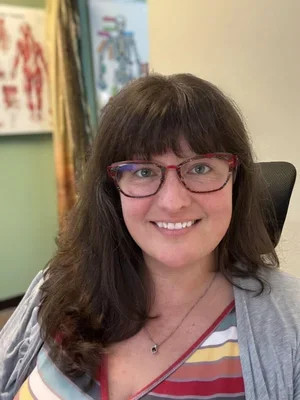
Kelly Clark is the founder of Patient PT and a licensed physical therapist who brings a unique perspective shaped by her own decade-long journey through misdiagnosed chronic pain and overuse injury. Drawing on her experiences as both a patient and former massage therapist, she's dedicated to providing approachable, affordable, patient-centered care that empowers people with chronic pain to manage their symptoms independently for the long term.
Connect with Kelly:

Meet Destiny - The host of The Chronic Illness Therapist Podcast and a licensed mental health therapist in the states of Georgia and Florida. Destiny offers traditional 50-minute therapy sessions as well as therapy intensives and monthly online workshops for the chronic illness community.