For licensed professional counselors, social workers, certified rehabilitation counselors, physical therapists, and occupational therapists who specialize in working with chronically ill clients
The Countertransference & Chronic Illness Intensive
hosted by Destiny Davis LPC, CRC & Victoria Rodriguez LPC, PhD

You See Your Client's Name on Your Schedule and Your Stomach Drops
Not because they're a "bad" client… of course not. But because you feel their helplessness. Their hopelessness seeps through the screen - or coffee table - and you can't tell anymore… is this my own clinical insight or am I drowning in their experience because it mirrors my own?
You're not alone. Over 225 therapists signed up for this training in Jan 2026 because they needed answers to questions like:
How do I stay present when my client's medical trauma is identical to mine?
When do I disclose my chronic illness… and when does that disclosure serve me instead of them?
How do I know if I'm over-functioning because of saviorism or under-functioning because I'm burned out?
What do I do when both me AND my client have to cancel because of our conditions?
How do I stop feeling guilty about my accommodation needs when I'm teaching clients to advocate for theirs?
What You Get in This 3-Hour Intensive
Framework #2: The Epistemic Injustice** Lens
Put words to what your chronically ill clients (and you) have experienced:
Testimonial injustice: When doctors deflate your credibility ("You're too young to be that sick")
Hermeneutical injustice: When there's no language to explain your experience so people just... don't believe you
"It took me 14 years to get a diagnosis. Doctors kept saying it was 'just anxiety' or to 'lose weight.'" - Multiple participants shared versions of this story. This training explains WHY it happens and how to work with it clinically.
** coined by Miranda Fricker

Framework #1: "Danger in Me, Safety in Me*"
Analyze why your nervous system goes haywire with certain clients. Learn the descending inhibitory modulation pathway (in plain English) and how to identify your personal danger/safety signals before you're already activated.
One participant realized: "The crumbs on my feet while doing dishes is a danger signal" - and suddenly understood why certain session interruptions felt so destabilizing.
* coined by Lorimer Mosely
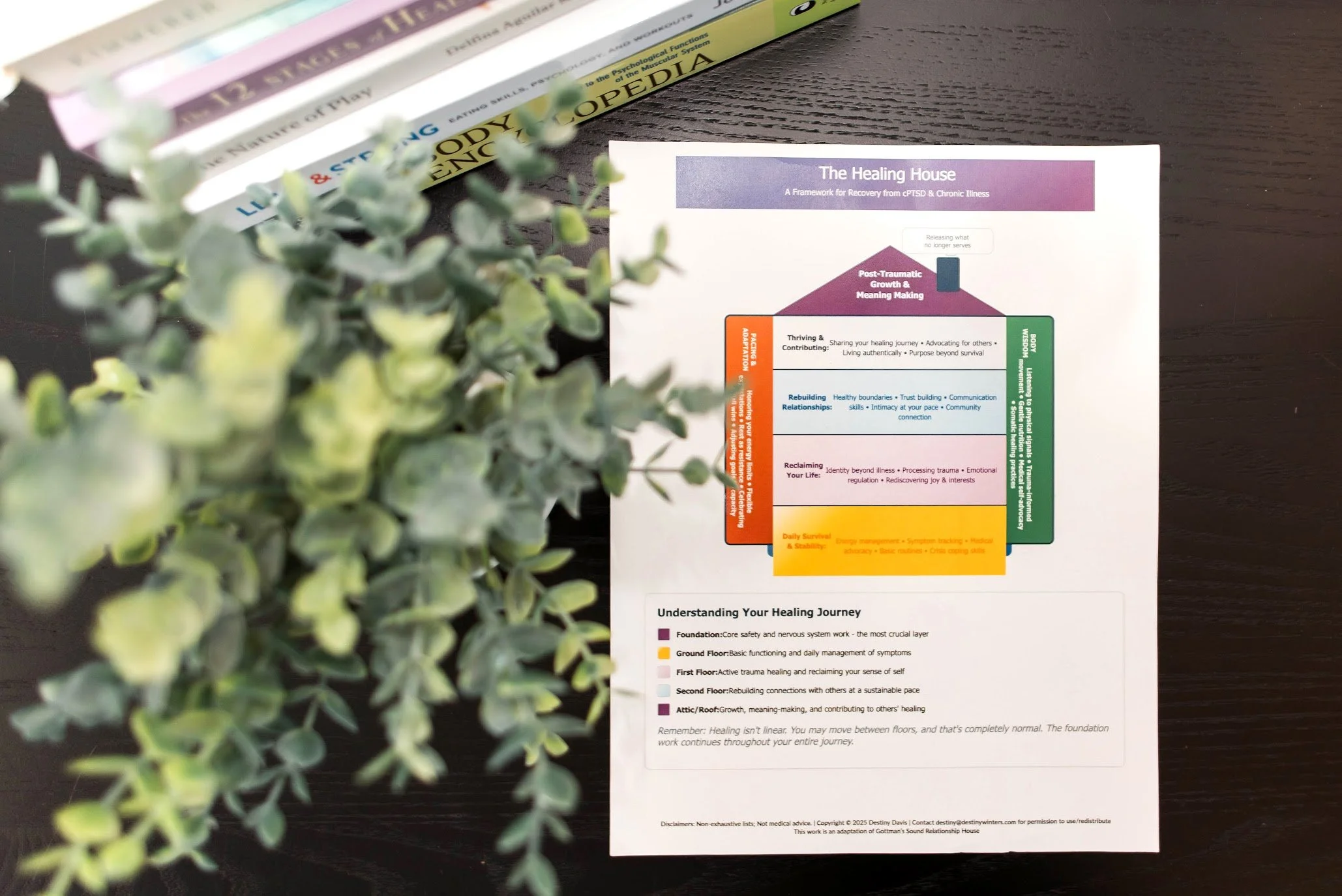
Framework #3: The Self-Disclosure Decision Tree
Stop second-guessing every disclosure. Learn to ask:
Who does this serve… mine or theirs?
Am I disclosing strategically or reactively?
What am I hoping for when I visualize sharing this?
What's the clinical benefit vs. potential burden?
Hear From Past Consultation Group Members
Dr. Tera L.
“I love what Destiny has done with Chronic Illness Therapist education & support. She is skilled, professional, and very relatable. It is evident that she has a true passion for this work and really "gets it". I appreciate her clinical wisdom and dedication to developing a space for chronic illness-informed practitioners to grow. I have learned so much and simultaneously felt so supported!”
Lisa T.
“I initially found Chronic Illness Therapists through the podcast, which I have found to be so helpful personally as well as for sharing with clients and friends. Later I connected with Destiny for consultation as a fellow chronic illness therapist, and I have found her clinical and business consultation groups to be invaluable sources of insight and community.”
Anon
“I found them on FB. And the connection and information I’ve found here has been life-changing. Grad school caused me to lose my spark because I believed I couldn’t be a therapist due to my own disabilities. I now know that that is far from the case. I am incredibly grateful to have found this resource and the support it provides me as a therapist with disability and chronic illness.”
Megan S.
“I originally found Destiny a few years ago through her podcast and was immediately impressed by her wealth of knowledge about working with folks with chronic illness. When I shifted into my private practice full time, I started to join her consultation groups and these have been a phenomenal resource. All of her spaces are inclusive and welcoming. The depth of knowledge, connection and community she has created for both practitioners and people living with chronic illness is remarkable.”
Tiffany P.
“As a registered dietitian specialized in eating disorders, chronic illness, and complex medical conditions, I wouldn’t hesitate to refer a client to Destiny for therapy, or refer a clinician colleague to the trainings and workshops she offers. Destiny is a therapist, but also understands much more than the average therapist in this space. She gets the in-depth science, medical nuances, and knows what it feels like first hand to have lived experience of navigating life with a chronic illness. Though therapists without lived experience can make a difference too, especially when it comes to the space of chronic illness, it can be so transformative to have a clinician that’s been through it too and gets it, at both a professional and personal level.”
Real Case Consultations with Actual Solutions

Case #1: Long-term client who won't do homework, seems helpless, and the therapist feels trapped (especially because of the income pressure).
What we covered:
How to distinguish between executive dysfunction and "resistance"
The tantrums framework (short burst emotional overwhelm that will pass)
Bringing consent language into stuck sessions
When the client might benefit from splitting care (weekly skills work with an intern + monthly deeper processing with you)
This Training Is Different Because the Facilitators GET IT
Destiny Davis, LPC, CRC (GA/FL/CO): Specializes exclusively in chronic illness. Has lived experience with multiple diagnoses. Grew up with a blind and paraplegic father and a mother with multiple chronic illnesses. Hosts the Chronic Illness Therapist podcast.
Victoria Rodriguez, PhD (she/her): All-telehealth practice specializing in chronic illness and medical trauma. Research focused on theory application and trauma treatment in chronic illness settings. Will be walking around the March conference with electrolyte packets for POTS folks.
They're not just teaching theory… they're teaching what works when YOU are the one managing symptoms while holding space for someone else's.

If The Community Aspect Was Unmatched in Our Virtual 3-Hour Intensive, Imagine What It’ll Be Like In Our 6-Week Chronic Illness Cohort!
This 3-hour training replay is the perfect pre-work for the cohort (totally optional pre-work, of course!) — Will you be joining us?! We start on April 7th, 2026.
The chat became its own mini-training:
"I have been feeling so much warmth and gratitude about all the accessibility efforts"
"Honestly, since moving into private practice and having more control, I've felt so much better about everything. I worked at agencies for 8 years and it ground me up." (Multiple 💯 reactions)
"I am learning what it means to be an authentically presenting chronically ill neurodivergent clinician and it is beautiful." (8+ heart reactions)
Participants spontaneously shared:
Resources (askjan.org for workplace accommodations, NOI group apps for chronic pain - with caution about how we teach pain science to clients without gaslighting)
Book recommendations (Adult Children of Emotionally Immature Parents, Power, Resistance, and Liberation in Therapy)
Their own medical gaslighting stories that validated others
Practical tips for everything from therapist chairs to crisis protocols

Want Live, Ongoing Clinician Consultation and Chronic Illness Therapy Topics? Join us in our 6-week cohort!
Case #2: Therapist dreading sessions because client has multiple complex conditions and nothing seems to move forward.
What we explored:
How to check: Is this their ambivalence or my urgency to fix?
Working WITH ambivalence instead of pushing through it
The Google Drive system for resources (so they're there when clients ARE ready)
Getting curious: Why is THIS problem "the hinge point"?

What's Included in Your Countertransference Replay Access
✅ Full 3-hour recording (with identifying information edited out for case consultations)
✅ Complete slide deck with all frameworks, self-check-in questions, and decision trees
✅ Resource list including all tools mentioned (VIA Strengths Survey, danger/safety signals worksheet, self-disclosure decision framework)
✅ Case consultation examples - hear how experienced clinicians work through real countertransference dilemmas
✅ Bonus: Access to the Chronic Illness Therapists Conference Facebook Group for ongoing peer support

Who This Training Is For
✅ You're a therapist with chronic illness/disability treating chronically ill clients
✅ You specialize in chronic illness but wonder if your own experience is helping or hindering
✅ You feel "stuck" with certain clients and can't tell if it's them, you, or both
✅ You struggle with disclosure decisions
✅ You're trying to figure out your own accommodations while running a practice
✅ You want case consultation from people who actually understand the dual experience
Who This Training Is NOT For
❌ You're looking for basic chronic illness 101 (this assumes you already work with this population)
❌ You want a lecture-only format with no experiential work
❌ You're not interested in examining your own countertransference
❌ You believe therapists shouldn't disclose anything ever, and you’re not open to a different perspective
Fair Warning: This Training Goes Deep
The experiential exercises are labeled by intensity (light/medium/heavy) and you can opt out of any of them. But this isn't a surface-level training.
You'll be asked to:
Visualize yourself "zooming out" above your therapy chair to observe what's happening
Identify your personal danger/safety signals
Examine where YOU have experienced epistemic injustice
Notice what comes up in your body when you think about specific clients
Participants appreciated this:
"The experiential exercises were helpful - I loved the structure and levels associated with them"


Regular Price: $145
Special Bonus Price: $0 when you join the Skool community!
You're not just getting a training - you're joining a network of clinicians who GET IT from lived experiences as well as professional ones.
-
A: This training will still be valuable for the frameworks and case consultations. Especially if you have some biases that need to be examined (as we all do). However, much of the content specifically addresses the dual experience of being chronically ill yourself while treating chronically ill clients.
-
2.75 NBCC and CRCC hours available.
The Chronic Illness Therapist has been approved by NBCC as an Approved Continuing Education
Provider, ACEP No. 7980. Programs that do not qualify for NBCC credit are clearly identified. The
Chronic Illness Therapist is solely responsible for all aspects of the programs.
Course Description
This 3-hour intermediate-level workshop explores countertransference dynamics when working with chronically ill clients, with particular emphasis on clinicians who themselves have chronic health conditions. Participants will examine how their own experiences with chronic illness, medical trauma, and healthcare systems influence their therapeutic relationships and clinical decision-making. The workshop addresses epistemic injustice in healthcare settings, strategic self-disclosure considerations, and the identification of danger and safety signals in both therapists and clients. Through experiential exercises, case consultations, and evidence-based frameworks, participants will develop practical strategies for recognizing and managing countertransference, establishing appropriate boundaries, and implementing accommodations that support both clinical effectiveness and therapist wellness. This training is designed for mental health professionals, rehabilitation counselors, and allied health professionals who work with chronically ill populations.
Learning Objectives
Upon completion of this workshop, participants will be able to:
Identify and differentiate between personal countertransference reactions and clinical insight when working with chronically ill clients, utilizing self-assessment frameworks including danger/safety signals and somatic awareness techniques.
Analyze the impact of epistemic injustice (both testimonial and hermeneutical) on chronically ill clients' therapeutic experiences and apply strategies to address medical gaslighting and invalidation within the therapeutic relationship.
Evaluate self-disclosure decisions using a clinical decision-making framework that considers therapeutic benefit, potential burden, strategic versus reactive disclosure, and the intersection of therapist and client identities and chronic health conditions.
ACEP Number: 7980
CRCC Sponsor Code: 741147