
Writing things down before your appointment gives your doctor a clear, specific picture of your life, and gives you something to hold onto when your nervous system is busy bracing for the visit.
When we're scared of not being believed, our bodies often shift into a threat response in the exam room. Memory gets patchy, we minimize, we forget the thing we came in for, or we say "I'm fine" out of habit. None of that means you're doing it wrong. It means your brain is protecting you. A written page does the remembering for you so you don't have to perform calm in order to be heard.
You don't need to fill in every section. Start with the one that feels most important, and bring this page (or a printed one-page summary of it) with you.
1. Your main ask for this visit
Most appointments are 7 to 20 minutes, so naming one clear request helps your doctor know what you need from them today. Lead with this sentence when they walk in.
Try finishing one of these:
"Today I'd like us to figure out a next step for ____________."
"I'm here because ____________ has changed, and I want to talk about testing, strategies, etc. for ____________."
"The most important thing I need to leave with is ____________ (a referral, a test, a medication change, documentation)."
My main ask: ______________________________________________
If there's time, I'd also like to talk about: _______________________
2. Your symptoms
Patterns are more useful to a doctor than a long list. For your top two or three symptoms, jot down:

Alt text: A blank fill-in table for tracking symptom patterns. It has five columns: Symptom, When it started, How often or how long, What makes it worse, and What helps (even a little). There are three empty rows, so the reader can write in their top two or three symptoms and the details for each.
Also worth noting:
What's new or different since your last visit with this doctor.
Clusters: symptoms that tend to show up together (for example, dizziness and racing heart when standing).
Triggers or timing: after meals, after activity, the day after exertion, with your cycle, with weather, in the morning.
Rough ratings: a 0 to 10 on a typical day and on a bad day, so they can see the range rather than just today.
3. How this is affecting your daily life
This is often the section that moves a doctor the most. "I'm tired" can sound like something everyone feels. "I used to work a full shift, and now I need to lie down after showering. By the end of my workday, I have to lay flat in my car before driving home. I’m calling out of work one day a week and am about to lose my job" gives them a concrete change in function, which is also what insurance and referrals look for.
The simplest format is then vs. now: what you could do a year ago (or before symptoms started) compared to what you can do today.
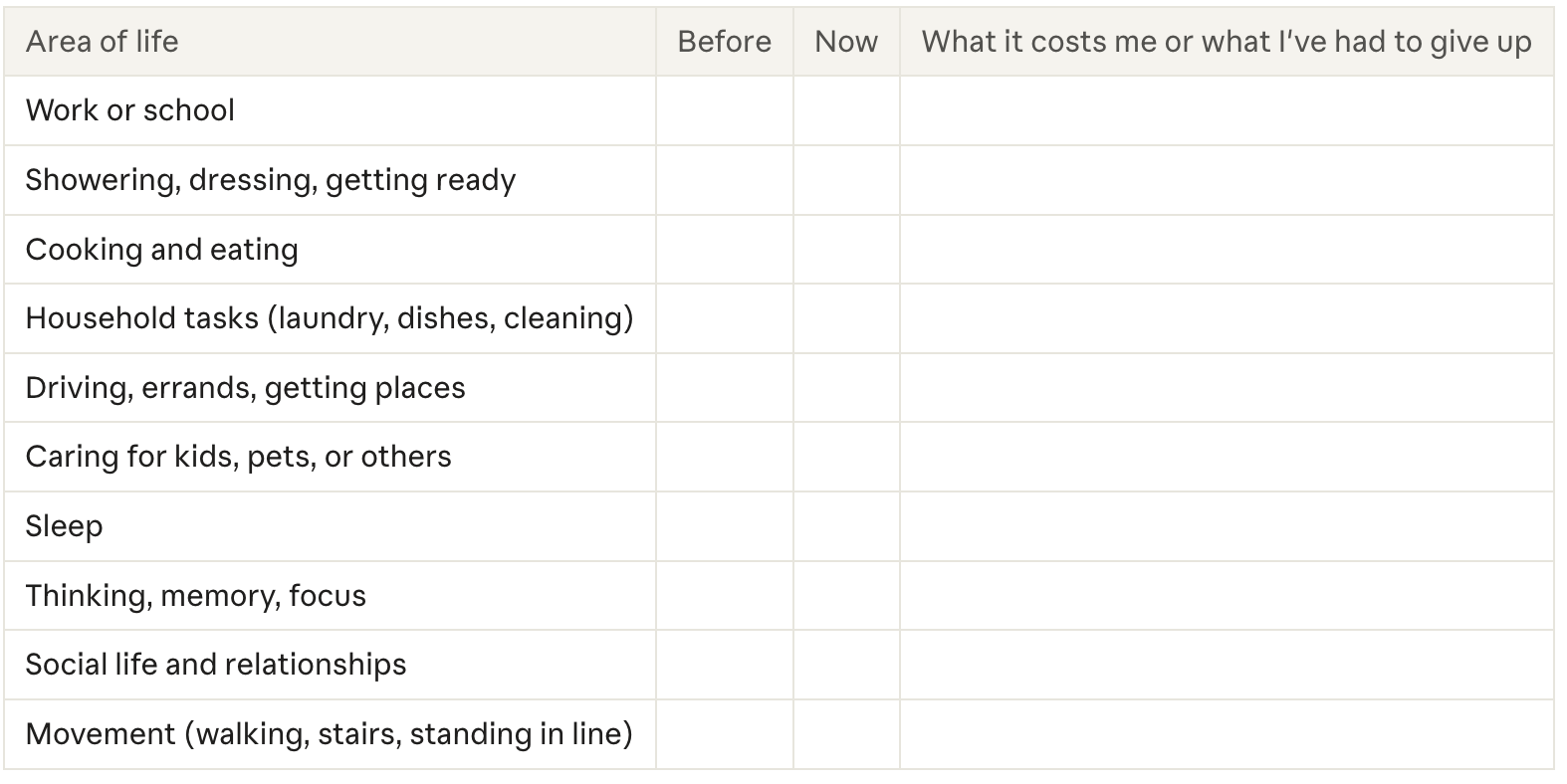
Alt text: A blank fill-in table for comparing daily functioning before symptoms began with now. It has four columns: Area of life, Before, Now, and What it costs me or what I’ve had to give up. There are ten rows, one for each area of life: work or school; showering, dressing, and getting ready; cooking and eating; household tasks like laundry, dishes, and cleaning; driving, errands, and getting places; caring for kids, pets, or others; sleep; thinking, memory, and focus; social life and relationships; and movement such as walking, stairs, or standing in line. Every cell except the area names is empty, for the reader to fill in.
A few prompts if you get stuck:
How many days in the last month were "bad days"? What did a bad day look like?
How long can you stand, sit, or walk before you need to stop?
What do you now need help with, or have stopped doing entirely?
What do you do to compensate (sitting to cook, ordering groceries, planning recovery days after outings)?
What does it cost you the next day when you push through?
You don't have to make it sound worse than it is, and you don't have to make it sound better either. Describing your actual day is enough.
4. What you've already tried
This saves time and keeps you from being sent back to step one. Include medications, supplements, lifestyle changes, therapies, and other specialists.
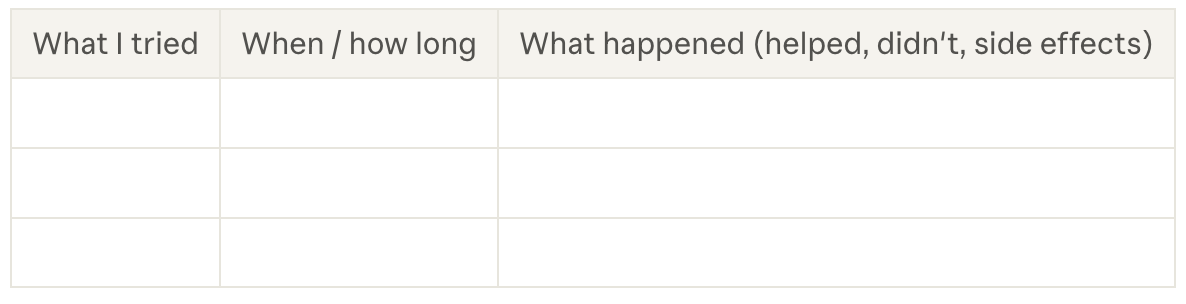
Alt text: A blank fill-in table for tracking symptom patterns. It has five columns: Symptom, When it started, How often or how long, What makes it worse, and What helps (even a little). There are three empty rows, so the reader can write in their top two or three symptoms and the details for each.
Also bring:
A current list of medications and supplements with doses.
Names of other providers you've seen for this, and any test results you have access to (patient portal printouts work).
5. Bringing up the diagnosis you're wondering about
You are allowed to bring research to your doctor. How you frame it shapes whether it lands as collaboration or as a challenge, so the goal is to share it as a question you want to explore together.
Before the visit, write down:
The condition you're wondering about: ______________________
Why it fits for you: the two or three specific symptoms or patterns that match, in your own words. Point back to your symptom and daily life sections above.
What made you think of it: a specialist's comment, a family history, a support group, an article.
What would help rule it in or out: if you've read about specific tests, criteria, or the type of specialist who usually evaluates it, note those.
What to bring:
One or two sources, not a stack. A recent peer-reviewed article, a diagnostic criteria page, or guidance from a major medical organization or patient foundation tends to carry more weight than social media or a blog.
Print it, and highlight the one or two paragraphs that matter. Doctors rarely have time to read a full article in the room, but they can read a highlighted section.
Write the article title, journal, and year at the top so they can look it up later.
Ways to say it:
"I came across some research on ____________ and some of it sounded a lot like what I'm experiencing. Can I show you what stood out to me?"
"I'm not trying to diagnose myself. I'd just like to know whether ____________ is something worth ruling out, and if not, what makes you think it doesn't fit."
"If this isn't something you usually evaluate, who would be the right person to refer me to?"
If your doctor disagrees, it's still useful to ask why. Their reasoning gives you information either way, and it belongs in your notes.
Ways to say it:
“What are you seeing that points you away from that?”
“Has it been ruled out, or does it just seem less likely right now?”
“Is there a test that could rule it out for sure, so we can both feel confident moving on?”
“If it’s not that, what do you think is the most likely explanation?”
“What would you want to rule out next?”
6. Questions to ask
Pick your top three and star them so they get asked even if time runs short.
What do you think is going on, and what else are you considering?
What tests would help narrow this down? If we're not doing them, what's the reason?
What's the plan if this next step doesn't help?
Is there a specialist I should see, and can you place the referral today?
What can I do in the meantime to manage ____________?
When should I follow up, and what changes should make me call sooner?
Is there a way to send you updates between visits (portal message, symptom log)?
My own questions:
7. If you start to feel dismissed
It helps to decide ahead of time what you'll say if the conversation stalls, because in the moment your body may want to shut down or apologize. Pick one or two of these and write them on your page:
"I hear that my labs look normal. My daily life is still very different from a year ago, and I'd like to understand what could explain that."
"Can we talk about what's changed in my ability to function, not just how I'm feeling today?"
"What would need to happen for you to consider testing for ____________?"
"If you're not going to order that test or referral, can you note in my chart that I asked and why it was declined?" - Be cautious with this one; it can come across as combative.
"I'd like a copy of today's visit notes."
Asking for something to be documented is a neutral, reasonable request. It keeps a record of your concerns and often prompts a second look.
It's also okay to pause. "Give me a second, I want to check my notes" is a complete sentence. “Can you repeat that so I can accurately write it down for my memory?” And if a visit doesn't go well, that tells you something about the fit with this provider. It doesn't tell you your symptoms aren't real or that you asked for too much.
8. The day of, and right after
Before you go:
Condense this into a one-page summary to hand your doctor: your main ask, top symptoms, the then vs. now changes, and the condition you want to discuss.
Consider bringing a support person, in person or on speakerphone, whose only job is to take notes or say "Can you explain that again?"
Plan something regulating for afterward: a snack, a quiet drive, a text to someone safe. Your body will likely need it whether the visit goes well or not.
Right after (in the car or waiting room, while it's fresh):
What did the doctor say they think is going on?
What's the plan: tests, referrals, medications, follow-up date?
What did I ask for that didn't happen, and what was the reason given?
How do I feel about this visit, and what do I want to do next?