
For a fillable word doc, enter your email here, and I’ll send one straight to your inbox!
More than a bedtime
Your circadian rhythm is not just about how sleepy you get at night or whether you looked at your phone before bed. It is a timing system that runs through nearly every tissue in your body, and it takes in time cues from light, food, movement, temperature, and the people and routines around you.
Scientists describe a master clock in the brain, called the suprachiasmatic nucleus (SCN), plus clocks in other parts of the body like the liver, gut, fat tissue, and muscles. Light sets the master clock, and the master clock helps coordinate the others through nerve signals, hormone rhythms, body temperature, and behaviors like eating (Wehrens et al., 2017). Those body clocks also respond to their own cues, so they can drift out of step with the brain (Borbély et al., 2016).
This guide walks through each cue so you can see what your body is listening to. None of it is a test to pass. With a chronic illness, many of these cues are partly outside your control, and that is information, not failure.
Two systems, not one
Sleep researchers use a model with two parts that work together (Borbély et al., 2016; Borbély, 2022).
Sleep pressure (Process S). This builds the longer you are awake and drains while you sleep. It is the part most people already know about.
Circadian timing (Process C). This is the clock. It sets when in the 24 hours your body is primed for alertness, rest, digestion, repair, and sleep, regardless of how long you have been awake.
This is why you can be exhausted and still feel wired at 11 p.m., or sleep a full night and still feel foggy at 7 a.m. Pressure and timing can disagree. Most sleep hygiene advice focuses on the first system and barely touches the second.
What the clock runs besides sleep
Circadian rhythms help regulate sleep and waking, core body temperature, the immune system, hormones, metabolism, thinking, and the stress response (Sleep Foundation). A few that matter in chronic illness:
Pain sensitivity. In a tightly controlled lab study, sensitivity to pain rose and fell across 24 hours. It peaked in the middle of the night and was lowest in the afternoon. The body clock accounted for about 80% of that swing and sleep pressure for about 20% (Daguet et al., 2022). The study only included healthy men, so it may not map onto your body, but it is one reason pain can feel louder at 3 a.m.
Immune activity and inflammation. Many parts of the immune system rise and fall on a daily schedule, which may help explain why some symptoms and flares cluster at certain times of day (Scheiermann et al., 2013).
Body temperature. Core temperature runs about 2 to 3°F higher in the late afternoon and early evening than during sleep, when it bottoms out (University of Texas at Austin, 2019).
Blood sugar and metabolism. Clocks in tissues like fat and liver shape how your body handles food at different times (Wehrens et al., 2017).
If your symptoms follow a daily pattern, that pattern is real information, not something you are imagining.
Light: the strongest cue, and it is about the whole day
Light reaches the body’s master clock through special light-sensing cells in the eye that contain a pigment called melanopsin (Brown et al., 2022). What matters is when light hits, how bright it is, and how dark your nights are.
Timing. Bright light in the early morning shifts your clock earlier. Light in the evening and late night shifts it later. Light in the middle of the day has smaller effects on timing (Youngstedt et al., 2019, describing the human light response curve).
Brightness. Indoor lighting is usually at least 10 times dimmer than outdoor light. An international expert panel recommends (Brown et al., 2022):
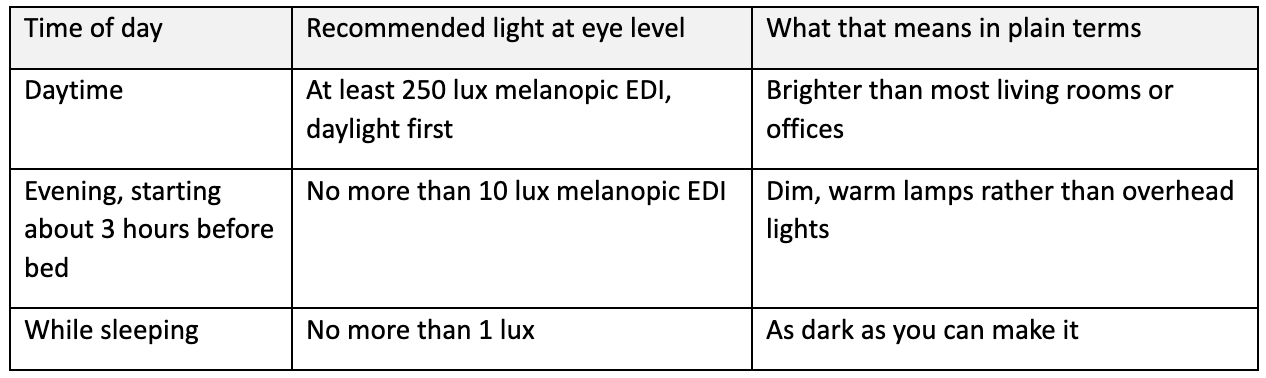
Alt text: Table of recommended light levels at eye level across the day. Daytime: at least 250 lux melanopic EDI, with daylight first, which is brighter than most living rooms or offices. Evening, starting about 3 hours before bed: no more than 10 lux melanopic EDI, meaning dim, warm lamps rather than overhead lights. While sleeping: no more than 1 lux, as dark as you can make it.
The blue light piece. Screens do matter, but they are only one slice of evening light, not the whole story. In one study, evening display light with less melanopic (blue-weighted) content helped people fall asleep faster and preserved melatonin better than high-melanopic light at the same brightness (Schöllhorn et al., 2023). Overhead room lighting, bathroom lights, and the TV all count too. The same panel also notes that brighter light earlier in the day may soften the effects of evening light, though that still needs more research (Brown et al., 2022).
Takeaway: a bright day plus a dim evening often matters more than a blue light filter alone.
Food timing: a cue for your body clocks
Researchers consider meal timing a real time cue for the circadian system, though weaker than light (Nature Reviews Endocrinology review, 2020). Meal timing mostly sets the clocks in your digestive and metabolic organs, not the main clock in your brain, which takes its cues mostly from light.
In a 13-day lab study, moving all three meals 5 hours later shifted the daily rhythm of blood sugar and of a clock gene in fat tissue. It did not shift melatonin or cortisol, which are markers of the master clock, and it did not change hunger or sleepiness (Wehrens et al., 2017). Put simply, your brain and your gut can end up on slightly different schedules.
What this means in practice:
Roughly similar meal times from day to day give your body clocks a steadier signal.
This is about regularity, not restriction. Nothing here asks you to skip meals or shrink an eating window. If you need small, frequent meals for POTS, gastroparesis, blood sugar, or medications, those needs come first.
Movement timing
Movement also nudges the clock, and the direction depends on the time of day. In a study of 99 adults doing an hour of moderate treadmill exercise, morning and afternoon sessions tended to shift the clock earlier, while evening sessions tended to shift it later (Youngstedt et al., 2019). Intense exercise in the evening can delay the clock by about 30 minutes to 2 hours (Flynn-Evans, U.S. Department of Energy presentation, 2021).
The cue is the timing of the activity, not the intensity. Gentle movement counts: stretching in bed, a few minutes of standing, or a short walk to the mailbox. If you live with post-exertional malaise (PEM), stay within your energy envelope. A small, steady daily movement anchor is a cue. A crash is not.
Temperature: your body cools down to fall asleep
Your core temperature follows its own daily curve. It drops by about 0.5 to 1°F in the hour or two before your usual sleep time (University of Texas at Austin, 2019). To get there, your body pushes heat out through your hands and feet. How much the blood vessels in the hands and feet open up was the best predictor of how quickly people fell asleep in one classic study (Kräuchi et al., 1999).
A research review found that a warm shower or bath (about 104 to 109°F) taken 1 to 2 hours before bed, for as little as 10 minutes, was linked to better sleep quality and falling asleep faster (Haghayegh et al., 2019). The warmth helps start the cool-down that follows.
If heat is hard on your body (POTS, dysautonomia, MS, or heat intolerance), a hot bath may not be safe or comfortable for you. The same cue can come from a cooler bedroom, warm socks, or warming just your hands and feet. Check with your care team before trying heat.
Social rhythm: people and routines are cues too
Researchers have long proposed that people, social demands, and daily tasks act as "social zeitgebers" that help set the biological clock. Losing them, through illness, job loss, grief, or isolation, may destabilize your rhythms and affect your mood (Ehlers, Frank & Kupfer, 1988). This idea became the basis of Interpersonal and Social Rhythm Therapy, which builds steadier daily routines around sleep and wake times, meals, and activity (Frank, Swartz & Boland, 2007).
Consistency itself seems to matter. In a study of about 61,000 adults wearing activity trackers, how regular people's sleep and wake times were predicted health outcomes better than how long they slept (Windred et al., 2024).
The five anchors from the Social Rhythm Metric are a good place to start (Mentalyc worksheet based on Frank et al.):
Time you get out of bed
Time of your first contact with another person (a text or call counts)
Time you start your main activity of the day
Time of dinner
Time you go to bed
When illness shrinks your world, these anchors often disappear first. Rebuilding even one or two gives your clock something to hold onto.
Chronotype: your clock has a setting
Some people are wired for earlier timing and some for later timing. This is called your chronotype, and it is partly genetic. One large study of nearly 700,000 people found 351 genetic regions linked to being a morning person (Jones et al., 2019). Being a night owl is not a character flaw.
Problems tend to show up when your schedule and your biology don't match. Researchers call the gap between your timing on work days and free days "social jetlag." In their research, the links to poorer sleep and wellbeing seemed to come from that mismatch, not from being a particular chronotype (Wittmann et al., 2006). Medical appointments, infusion schedules, and caregiving can all create this mismatch.
Caffeine, melatonin, and medications
Caffeine shifts the clock, not just sleep. In a controlled study, the amount of caffeine in a double espresso taken 3 hours before bed delayed the melatonin rhythm by about 40 minutes. That was close to half the delay caused by 3 hours of bright evening light (Burke et al., 2015).
Melatonin is a timing signal, not a sedative. Your body releases melatonin as darkness begins. The American Academy of Sleep Medicine supports strategically timed melatonin for certain circadian rhythm disorders, such as delayed sleep phase (Auger et al., 2015). Because timing and dose matter, talk with your doctor or pharmacist before using it.
Medications can have a best time of day too. A growing field called chronotherapy studies whether a medication works better or causes fewer side effects at certain times of day. One review points out that most drug research has been done with morning dosing, without strong evidence that morning is the best time (Clinical Pharmacology & Therapeutics review, 2021). Don't change when you take anything on your own, but you can ask your prescriber whether time of day matters for your medications.
When your body sets the limits
Most circadian advice assumes you can walk outside at sunrise, exercise on schedule, and eat whenever you like. Many people with chronic illness can't, and that is not a personal failing. Each cue has smaller versions you can use.
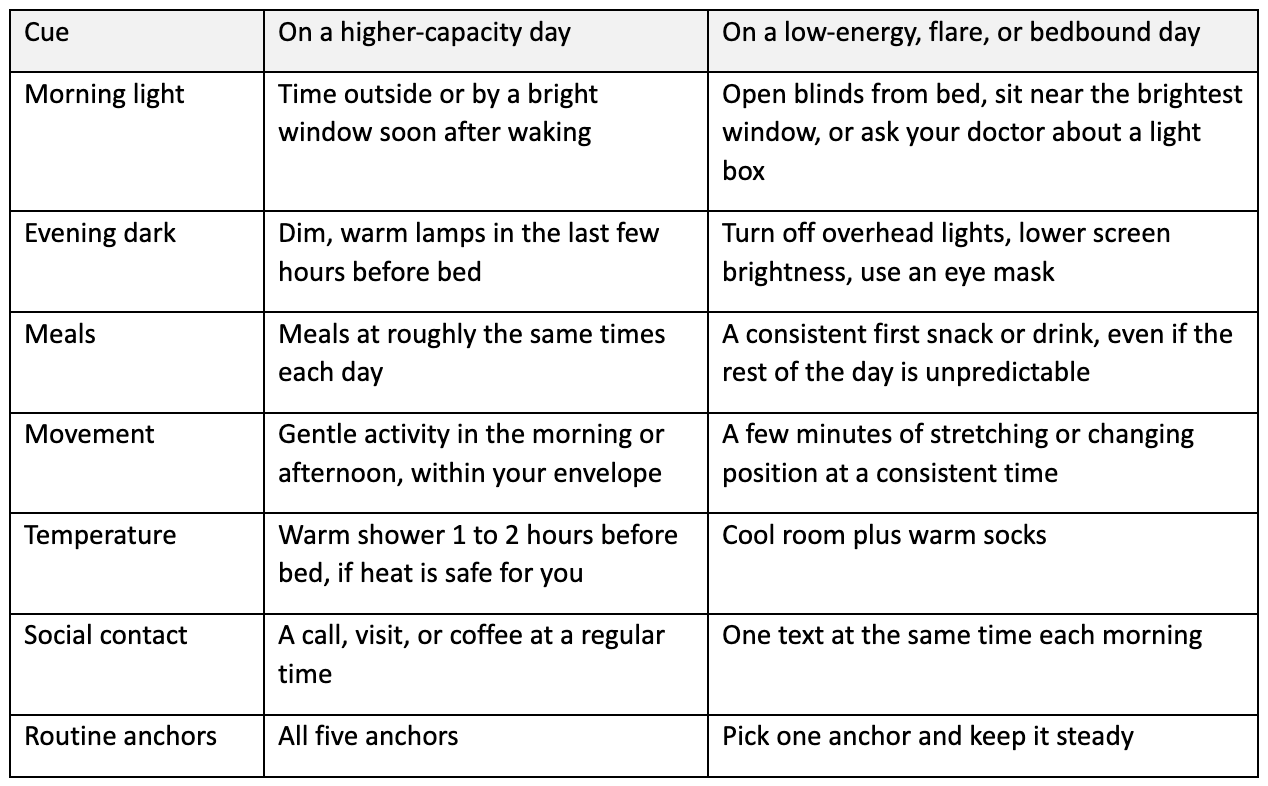
Alt text: Table comparing ways to support each circadian cue on a higher-capacity day versus a low-energy, flare, or bedbound day. Morning light: time outside or by a bright window soon after waking, or open blinds from bed, sit near the brightest window, or ask your doctor about a light box. Evening dark: dim, warm lamps in the last few hours before bed, or turn off overhead lights, lower screen brightness, and use an eye mask. Meals: meals at roughly the same times each day, or a consistent first snack or drink even if the rest of the day is unpredictable. Movement: gentle activity in the morning or afternoon within your energy envelope, or a few minutes of stretching or changing position at a consistent time. Temperature: a warm shower 1 to 2 hours before bed if heat is safe for you, or a cool room plus warm socks. Social contact: a call, visit, or coffee at a regular time, or one text at the same time each morning. Routine anchors: all five anchors, or pick one anchor and keep it steady.
Light boxes are not for everyone. Bright light therapy has been studied for circadian rhythm disorders and some forms of depression (Brown et al., 2022). If you have bipolar disorder, eye conditions, or light sensitivity (including migraine), they might be contraindicated. Always talk with your medical team first.
Your illness may shift your rhythm on its own. Medical conditions and medications can interfere with circadian rhythm and sleep (Sleep Foundation). A disrupted rhythm is not proof you did something wrong.
Choose your starting point by your capacity, not your symptoms. One steady cue that's easy to keep up is worth more than five you can't sustain.
Try this: a week of noticing
For one week, jot down what actually happened, without trying to change anything yet. You're gathering information, not getting graded.
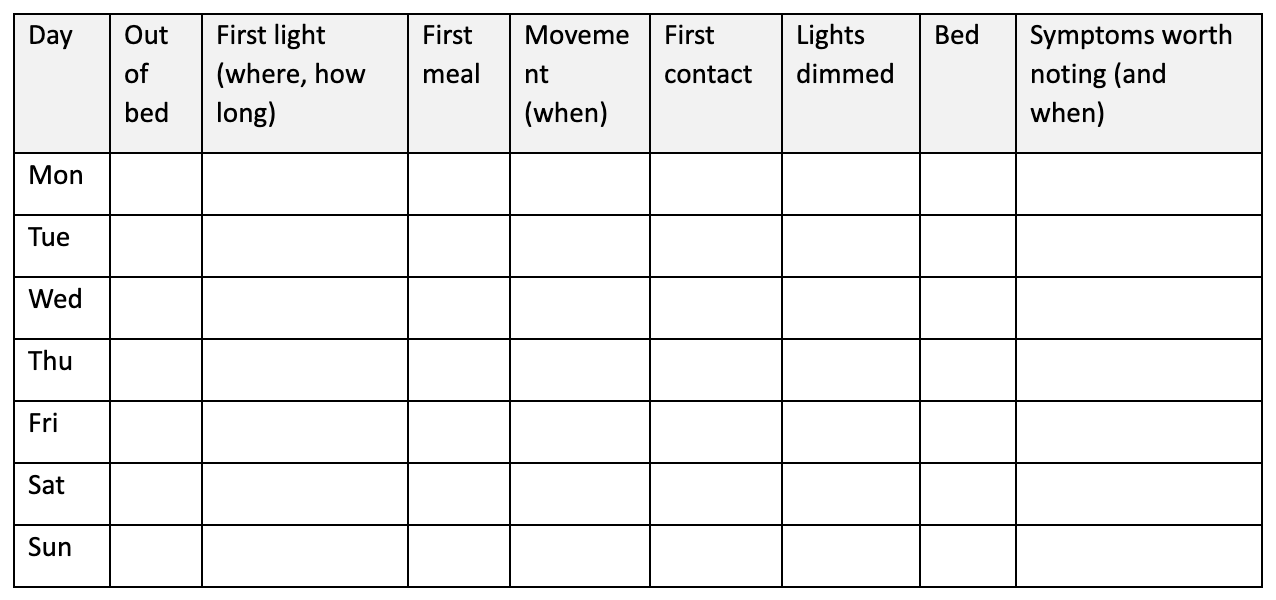
Alt text: Blank weekly tracking table with one row for each day, Monday through Sunday. Columns: out of bed, first light (where and how long), first meal, movement (when), first contact, lights dimmed, bed, and symptoms worth noting (and when). All cells are empty, ready to fill in.
At the end of the week, notice:
Which cue was most consistent? Which was most scattered?
Did any symptoms show up around the same time each day?
Which one cue feels most doable to steady, given your body this month?
Bring this to your next therapy session, and we can look at it together to see what went well, which obstacles popped up for you, and determine which goals align with your current capacity and values.
References
This handout is for education and does not replace individual medical advice.
Auger RR, Burgess HJ, Emens JS, Deriy LV, Thomas SM, Sharkey KM. Clinical practice guideline for the treatment of intrinsic circadian rhythm sleep-wake disorders: an update for 2015. J Clin Sleep Med. 2015;11(10):1199–1236. Link
Borbély AA, Daan S, Wirz-Justice A, Deboer T. The two-process model of sleep regulation: a reappraisal. J Sleep Res. 2016;25(2):131–143. Link
Borbély A. The two-process model of sleep regulation: beginnings and outlook. J Sleep Res. 2022;31(4):e13598. Link
Brown TM, Brainard GC, Cajochen C, et al. Recommendations for daytime, evening, and nighttime indoor light exposure to best support physiology, sleep, and wakefulness in healthy adults. PLoS Biol. 2022;20(3):e3001571. Link
Burke TM, Markwald RR, McHill AW, et al. Effects of caffeine on the human circadian clock in vivo and in vitro. Sci Transl Med. 2015;7(305):305ra146. Link
Circadian variation in efficacy of medications. Clin Pharmacol Ther. 2021;109(6):1457–1488. doi:10.1002/cpt.2073. Link
Daguet I, Raverot V, Bouhassira D, Gronfier C. Circadian rhythmicity of pain sensitivity in humans. Brain. 2022;145(9):3225–3235. Link
Ehlers CL, Frank E, Kupfer DJ. Social zeitgebers and biological rhythms: a unified approach to understanding the etiology of depression. Arch Gen Psychiatry. 1988;45(10):948–952. Link
Flynn-Evans E. Sleep and circadian rhythms (presentation). U.S. Department of Energy Solid-State Lighting R&D Workshop; 2021. Link
Frank E, Swartz HA, Boland E. Interpersonal and social rhythm therapy: an intervention addressing rhythm dysregulation in bipolar disorder. Dialogues Clin Neurosci. 2007;9(3):325–332. Link
Haghayegh S, Khoshnevis S, Smolensky MH, Diller KR, Castriotta RJ. Before-bedtime passive body heating by warm shower or bath to improve sleep: a systematic review and meta-analysis. Sleep Med Rev. 2019;46:124–135. Link
Jones SE, Lane JM, Wood AR, et al. Genome-wide association analyses of chronotype in 697,828 individuals provides insights into circadian rhythms. Nat Commun. 2019;10:343. Link
Kräuchi K, Cajochen C, Werth E, Wirz-Justice A. Warm feet promote the rapid onset of sleep. Nature. 1999;401:36–37. Link
Meal timing and the human circadian system (review). Nat Rev Endocrinol. 2020;16:213–223. doi:10.1038/s41574-020-0318-z. Link
Mentalyc. Daily Routine Worksheet (based on the Social Rhythm Metric). Link
Scheiermann C, Kunisaki Y, Frenette PS. Circadian control of the immune system. Nat Rev Immunol. 2013;13(3):190–198. Link
Schöllhorn I, Stefani O, Lucas RJ, Spitschan M, Slawik HC, Cajochen C. Melanopic irradiance defines the impact of evening display light on sleep latency, melatonin and alertness. Commun Biol. 2023;6:228. Link
Sleep Foundation. Circadian rhythm. Link
University of Texas at Austin, Cockrell School of Engineering. Take a warm bath 1–2 hours before bedtime to get better sleep. 2019. Link
Wehrens SMT, Christou S, Isherwood C, et al. Meal timing regulates the human circadian system. Curr Biol. 2017;27(12):1768–1775. Link
Windred DP, Burns AC, Lane JM, et al. Sleep regularity is a stronger predictor of mortality risk than sleep duration: a prospective cohort study. Sleep. 2024;47(1):zsad253. Link
Wittmann M, Dinich J, Merrow M, Roenneberg T. Social jetlag: misalignment of biological and social time. Chronobiol Int. 2006;23(1–2):497–509. Link
Youngstedt SD, Elliott JA, Kripke DF. Human circadian phase–response curves for exercise. J Physiol. 2019;597(8):2253–2268. Link
AI Clause
I used AI to help research and draft this handout. I then reviewed each section, checked the citations against the original studies, and edited the language to reflect my clinical perspective. The final content is mine, and so is responsibility for it. If you notice an error or have questions, bring them to session. It is for education only and is not a substitute for individual medical advice.

Alt text: A blank fill-in table for tracking symptom patterns. It has five columns: Symptom, When it started, How often or how long, What makes it worse, and What helps (even a little). There are three empty rows, so the reader can write in their top two or three symptoms and the details for each.
Also worth noting:
What's new or different since your last visit with this doctor.
Clusters: symptoms that tend to show up together (for example, dizziness and racing heart when standing).
Triggers or timing: after meals, after activity, the day after exertion, with your cycle, with weather, in the morning.
Rough ratings: a 0 to 10 on a typical day and on a bad day, so they can see the range rather than just today.
3. How this is affecting your daily life
This is often the section that moves a doctor the most. "I'm tired" can sound like something everyone feels. "I used to work a full shift, and now I need to lie down after showering. By the end of my workday, I have to lay flat in my car before driving home. I’m calling out of work one day a week and am about to lose my job" gives them a concrete change in function, which is also what insurance and referrals look for.
The simplest format is then vs. now: what you could do a year ago (or before symptoms started) compared to what you can do today.
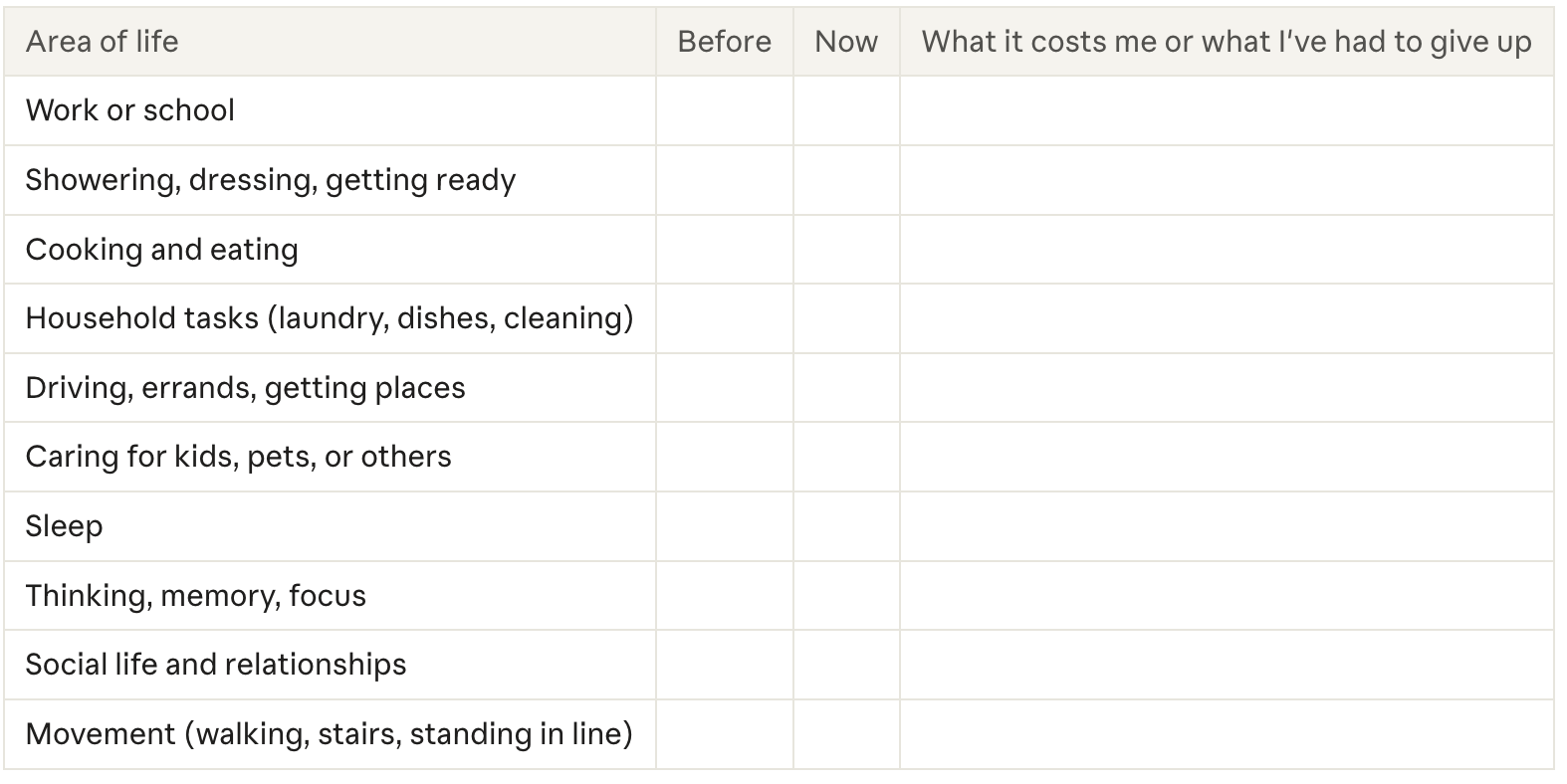
Alt text: A blank fill-in table for comparing daily functioning before symptoms began with now. It has four columns: Area of life, Before, Now, and What it costs me or what I’ve had to give up. There are ten rows, one for each area of life: work or school; showering, dressing, and getting ready; cooking and eating; household tasks like laundry, dishes, and cleaning; driving, errands, and getting places; caring for kids, pets, or others; sleep; thinking, memory, and focus; social life and relationships; and movement such as walking, stairs, or standing in line. Every cell except the area names is empty, for the reader to fill in.
A few prompts if you get stuck:
How many days in the last month were "bad days"? What did a bad day look like?
How long can you stand, sit, or walk before you need to stop?
What do you now need help with, or have stopped doing entirely?
What do you do to compensate (sitting to cook, ordering groceries, planning recovery days after outings)?
What does it cost you the next day when you push through?
You don't have to make it sound worse than it is, and you don't have to make it sound better either. Describing your actual day is enough.
4. What you've already tried
This saves time and keeps you from being sent back to step one. Include medications, supplements, lifestyle changes, therapies, and other specialists.
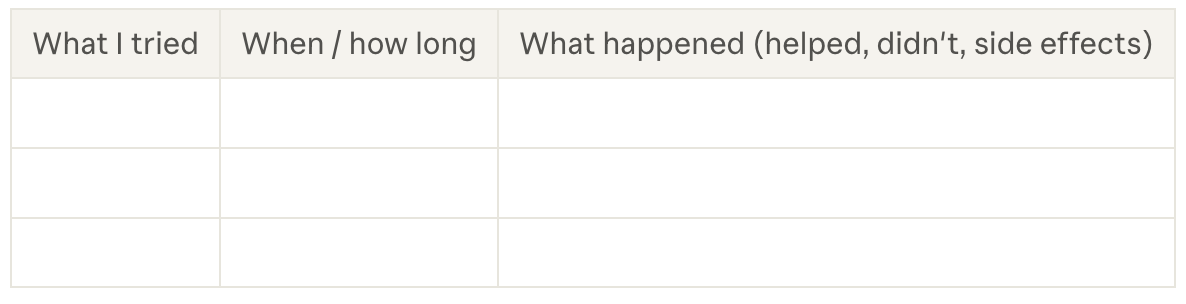
Alt text: A blank fill-in table for tracking symptom patterns. It has five columns: Symptom, When it started, How often or how long, What makes it worse, and What helps (even a little). There are three empty rows, so the reader can write in their top two or three symptoms and the details for each.
Also bring:
A current list of medications and supplements with doses.
Names of other providers you've seen for this, and any test results you have access to (patient portal printouts work).
5. Bringing up the diagnosis you're wondering about
You are allowed to bring research to your doctor. How you frame it shapes whether it lands as collaboration or as a challenge, so the goal is to share it as a question you want to explore together.
Before the visit, write down:
The condition you're wondering about: ______________________
Why it fits for you: the two or three specific symptoms or patterns that match, in your own words. Point back to your symptom and daily life sections above.
What made you think of it: a specialist's comment, a family history, a support group, an article.
What would help rule it in or out: if you've read about specific tests, criteria, or the type of specialist who usually evaluates it, note those.
What to bring:
One or two sources, not a stack. A recent peer-reviewed article, a diagnostic criteria page, or guidance from a major medical organization or patient foundation tends to carry more weight than social media or a blog.
Print it, and highlight the one or two paragraphs that matter. Doctors rarely have time to read a full article in the room, but they can read a highlighted section.
Write the article title, journal, and year at the top so they can look it up later.
Ways to say it:
"I came across some research on ____________ and some of it sounded a lot like what I'm experiencing. Can I show you what stood out to me?"
"I'm not trying to diagnose myself. I'd just like to know whether ____________ is something worth ruling out, and if not, what makes you think it doesn't fit."
"If this isn't something you usually evaluate, who would be the right person to refer me to?"
If your doctor disagrees, it's still useful to ask why. Their reasoning gives you information either way, and it belongs in your notes.
Ways to say it:
“What are you seeing that points you away from that?”
“Has it been ruled out, or does it just seem less likely right now?”
“Is there a test that could rule it out for sure, so we can both feel confident moving on?”
“If it’s not that, what do you think is the most likely explanation?”
“What would you want to rule out next?”
6. Questions to ask
Pick your top three and star them so they get asked even if time runs short.
What do you think is going on, and what else are you considering?
What tests would help narrow this down? If we're not doing them, what's the reason?
What's the plan if this next step doesn't help?
Is there a specialist I should see, and can you place the referral today?
What can I do in the meantime to manage ____________?
When should I follow up, and what changes should make me call sooner?
Is there a way to send you updates between visits (portal message, symptom log)?
My own questions:
7. If you start to feel dismissed
It helps to decide ahead of time what you'll say if the conversation stalls, because in the moment your body may want to shut down or apologize. Pick one or two of these and write them on your page:
"I hear that my labs look normal. My daily life is still very different from a year ago, and I'd like to understand what could explain that."
"Can we talk about what's changed in my ability to function, not just how I'm feeling today?"
"What would need to happen for you to consider testing for ____________?"
"If you're not going to order that test or referral, can you note in my chart that I asked and why it was declined?" - Be cautious with this one; it can come across as combative.
"I'd like a copy of today's visit notes."
Asking for something to be documented is a neutral, reasonable request. It keeps a record of your concerns and often prompts a second look.
It's also okay to pause. "Give me a second, I want to check my notes" is a complete sentence. “Can you repeat that so I can accurately write it down for my memory?” And if a visit doesn't go well, that tells you something about the fit with this provider. It doesn't tell you your symptoms aren't real or that you asked for too much.
8. The day of, and right after
Before you go:
Condense this into a one-page summary to hand your doctor: your main ask, top symptoms, the then vs. now changes, and the condition you want to discuss.
Consider bringing a support person, in person or on speakerphone, whose only job is to take notes or say "Can you explain that again?"
Plan something regulating for afterward: a snack, a quiet drive, a text to someone safe. Your body will likely need it whether the visit goes well or not.
Right after (in the car or waiting room, while it's fresh):
What did the doctor say they think is going on?
What's the plan: tests, referrals, medications, follow-up date?
What did I ask for that didn't happen, and what was the reason given?
How do I feel about this visit, and what do I want to do next?